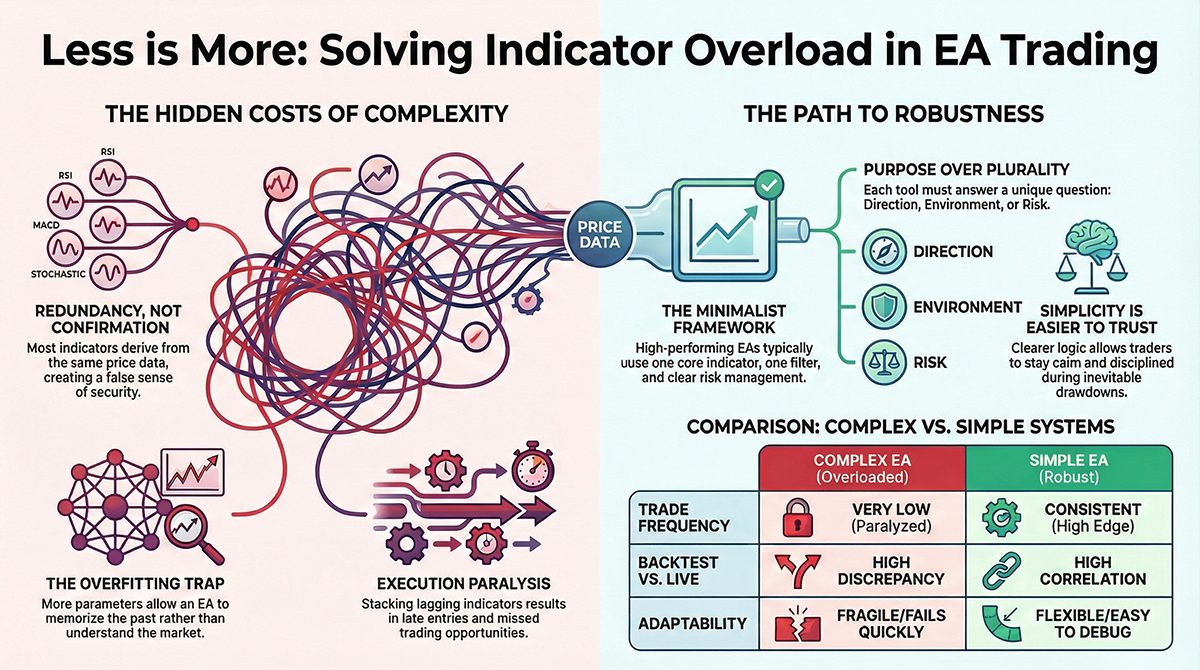
If you have ever built an EA, you have probably felt this temptation:
“If I add one more indicator, the signals will be safer.”
RSI to confirm entries.
MACD to confirm momentum.
ADX to confirm trend strength.
Bollinger Bands to confirm extremes.
ATR to confirm volatility.
Before you realize it, your EA needs five indicators to agree before it can trade.
At 1kPips, this pattern shows up constantly in struggling EAs. Ironically, the more indicators traders add, the worse performance often becomes.
This article explains why indicator overload hurts EA performance, how signal conflict and overfitting sneak in quietly, and why simpler systems usually survive longer in real markets.
The Illusion of Safety
Adding indicators feels logical.
More confirmation should mean fewer bad trades, right?
In reality, what usually happens is:
- Good trades are filtered out
- Entries become late
- Trade frequency collapses
- Edge erodes slowly
Markets do not wait for five indicators to agree.
By the time everything aligns, the opportunity is often gone.
Indicators Are Not Independent
This is a critical misunderstanding.
Most indicators are derived from the same price data.
RSI, MACD, Stochastic, and moving averages all respond to:
- Price change
- Price momentum
- Price volatility
They are not separate sources of information.
They are different views of the same thing.
Combining correlated indicators does not increase confidence. It increases redundancy.
Signal Conflict Is Inevitable
When too many indicators are combined, conflict is guaranteed.
For example:
- RSI says oversold
- MACD says momentum is still down
- ADX says trend is weak
- Bollinger Bands say volatility is expanding
What should the EA do?
In many systems, the answer becomes:
“Do nothing.”
This leads to:
- Missed trades
- Inconsistent behavior
- Fragile logic dependent on exact timing
Signal conflict does not improve quality. It paralyzes decision-making.
Indicator Overload Encourages Overfitting
The more indicators you add, the more parameters you introduce.
More parameters mean:
- More optimization combinations
- More curve fitting risk
- Less generalization
An EA with ten indicator parameters can always be optimized to look good on historical data.
That does not mean it understands the market.
It means it memorized the past.
Why Backtests Lie More With Complex Logic
Complex indicator stacks often produce:
- Beautiful equity curves
- High win rates
- Very low trade counts
This feels impressive.
But low trade count systems are statistically fragile.
A few trades define the entire backtest.
Change market conditions slightly, and the performance collapses.
Latency and Execution Make It Worse
Each indicator adds delay.
Most indicators lag by design.
When multiple lagging indicators are stacked:
- Entries happen late
- Stops are closer to exhaustion points
- Risk-to-reward deteriorates
In live trading, spread, slippage, and execution delays amplify this problem.
Backtests hide it. Live trading exposes it.
Simplicity Is Not Naivety
Many traders associate simple systems with beginner logic.
Professionals know better.
Simple systems:
- Are easier to understand
- Are easier to debug
- Are easier to adapt
- Break more gracefully
Complex systems fail in unpredictable ways.
What “Enough” Indicators Looks Like
Most robust EAs use:
- One core concept indicator
- One regime or volatility filter
- Clear, independent risk management
That’s it.
Everything else is often noise.
Indicators should answer different questions:
- Direction
- Environment
- Risk
If two indicators answer the same question, one of them is probably unnecessary.
Why Fewer Indicators Improve Confidence
Confidence does not come from agreement.
It comes from understanding.
When you know exactly why a trade exists:
- You trust drawdowns more
- You panic less during losing streaks
- You can improve the system logically
Indicator overload hides logic instead of clarifying it.
A Practical Test
Ask yourself:
- Can I explain my entry in one sentence?
- Does each indicator serve a unique purpose?
- Would removing one indicator break the idea?
If removing an indicator does not change the core logic, it probably never mattered.
Complexity Feels Smart, Robustness Makes Money
Markets reward robustness, not cleverness.
Combining too many indicators creates systems that look intelligent but behave fragile.
At 1kPips, we see long-term performers built on clear ideas, minimal indicators, and strong risk control.
Simplicity is not about doing less.
It is about doing only what matters.
Comments