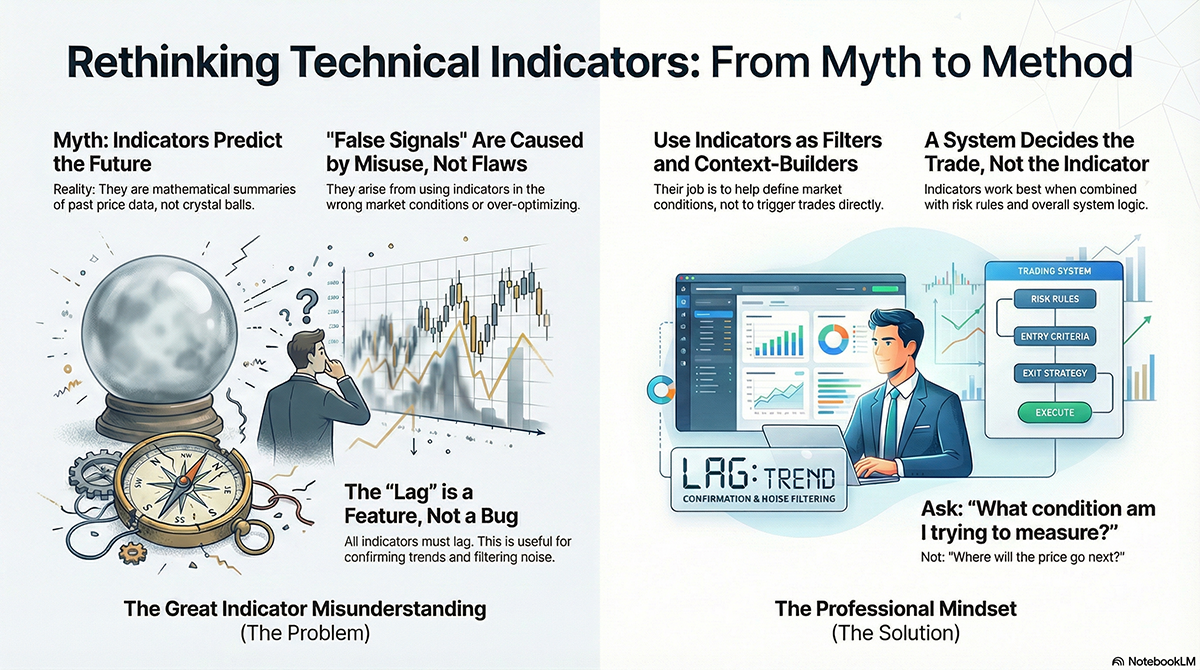
If you have ever loaded RSI, MACD, Bollinger Bands, and a few moving averages on your chart and thought, “Now this looks professional,” this article is for you. Indicators are not useless. But they also don’t work the way most traders believe they do. Especially if you are building EAs, signals, or performance-driven systems. Let’s break some myths, explain what indicators really are, and how to use them without lying to yourself.
The Biggest Indicator Myth
The most common belief is simple:
Indicators tell you where price will go next.
This belief is wrong.
Technical indicators do not predict the future. They describe the past, using math. Every indicator is a transformation of price data that already happened. Once you understand this, your entire approach to technical indicators changes.
What Technical Indicators Actually Are
At their core, technical indicators are:
- Mathematical summaries of price
- Filters that reduce noise
- Context builders, not decision makers
A moving average is not a magic trend line. It is simply the average of past prices. RSI is not “overbought or oversold” by default. It is a normalized momentum calculation. Indicators compress information. Compression always comes with loss.
Lagging Indicators Are Not the Enemy
One of the most abused phrases in trading is:
“That indicator is lagging.”
Yes, indicators lag. They must lag. If an indicator did not lag, it would be using future data. The real problem is not lag. The problem is misunderstanding what lag is useful for.
Lagging indicators are excellent at:
- Confirming regime changes
- Filtering low-quality signals
- Preventing over-trading
In EA design, lag is often a feature, not a bug.
Why False Signals Happen So Often
Traders blame indicators for false signals. But indicators do exactly what they are designed to do.
False signals usually come from:
- Using indicators in the wrong market regime
- Applying fixed thresholds to dynamic markets
- Over-optimizing parameters in backtests
RSI in a strong trend will stay “overbought” for weeks. Bollinger Bands in low volatility will generate endless fake breakouts. The indicator is not broken. The assumption is.
Indicators vs Price: A False Debate
Many traders say:
“I only trade pure price action. No indicators.”
Here is the uncomfortable truth:
If you visually judge structure, momentum, or volatility, you are still using indicators. They are just running inside your head.
The difference is simple:
- Manual trading uses subjective indicators
- EAs require explicit indicators
For systems and signals, clarity beats intuition every time.
Why Indicators Fail in Backtests but Shine in Live Systems
Many traders abandon indicators after seeing unstable backtest results. This is often due to:
- Curve fitting
- Too many combined indicators
- Ignoring execution realities
In live EA trading, indicators work best when:
- They define conditions, not entries
- They act as filters, not triggers
- They are combined with risk rules
Performance comes from structure, not signals.
How We Use Indicators at 1kPips
On 1kPips, indicators are never used alone. They are part of a system.
Typical roles include:
- Trend qualification (not prediction)
- Volatility filtering
- Session-based behavior control
No indicator decides a trade. The system does.
Indicator Myths You Should Let Go
- There is a perfect indicator setup
- More indicators mean better accuracy
- Indicators should work on all pairs and timeframes
- Indicators alone can replace risk management
Once these myths are gone, indicators become powerful tools instead of constant disappointments.
The EA Developer Mindset
For EA builders, indicators should answer one question:
“What condition am I trying to measure?”
Not:
“Where will price go next?”
Indicators measure state. Your logic decides action.
Comments