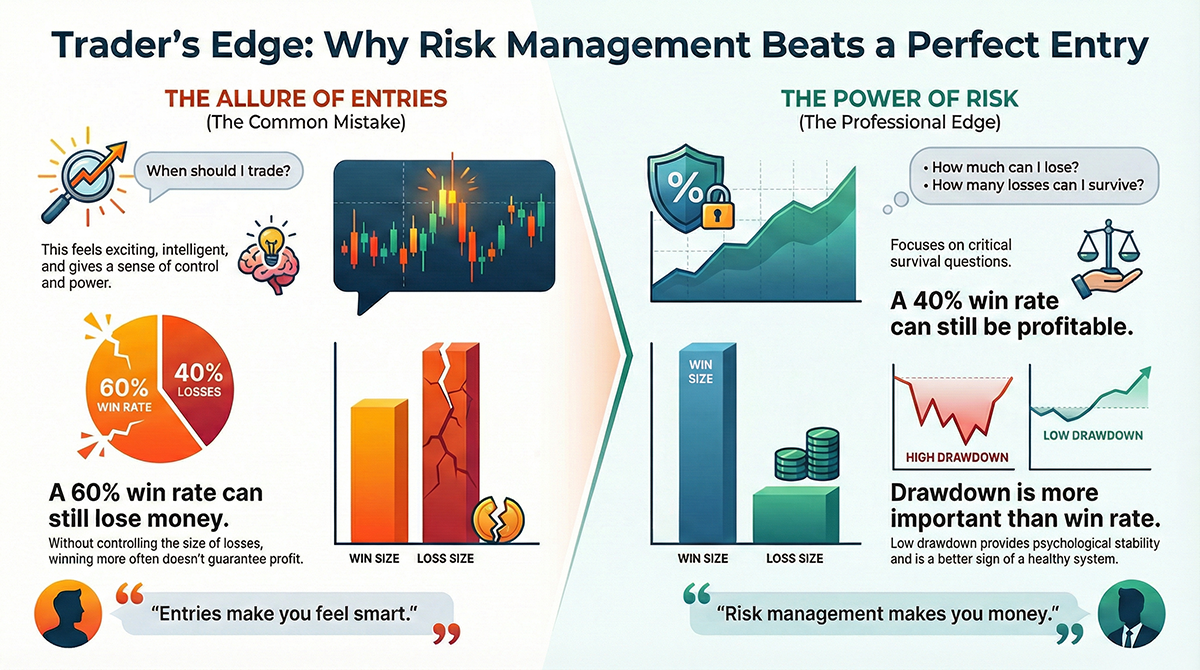
If you spend time in trading communities, you will notice a pattern. Most discussions revolve around entries: the perfect indicator, the best signal, the cleanest setup. But when you look at long-term performance data, especially from automated trading systems, a different truth appears.
Risk management, not entry precision, is what separates profitable traders from blown accounts.
At 1kPips, we focus on EA performance, real track records, and survivability. From that perspective, this article explains why trading risk management matters more than your entry strategy, and how EA traders should think about it in practice.
1. Entries Decide When You Trade. Risk Management Decides If You Survive.
An entry strategy answers one question:
- Should I buy or sell now?
Risk management answers far more important questions:
- How much can I lose if this trade fails?
- How many losses in a row can I survive?
- How long can this EA stay alive in bad market conditions?
You can be right 60 percent of the time and still lose money if your risk is uncontrolled. You can be right only 40 percent of the time and still grow your account if your losses are small and controlled.
This is why professional traders often say:
Entries make you feel smart. Risk management makes you money.
2. Why EA Traders Feel This More Than Manual Traders
Manual traders usually stop trading when things feel wrong. EAs do not have feelings. They execute exactly what you coded.
That makes risk management even more critical for automated trading:
- EAs trade during bad conditions unless explicitly blocked
- EAs can stack losses faster than humans expect
- One bad parameter can destroy months of gains
If your EA has strong entries but weak risk rules, it will eventually hit a market regime where those entries fail repeatedly.
Without proper protection, that is how accounts die.
3. Position Sizing Is the Real Strategy
Most traders underestimate position sizing. They treat it as a simple lot calculation.
In reality, position sizing is your core strategy.
Bad Position Sizing Looks Like This
- Fixed lots regardless of balance
- Increasing lot size after losses
- No cap on total exposure
This approach works perfectly until it does not.
Professional Position Sizing Looks Like This
- Risk per trade defined as a percentage of equity
- Maximum total risk across open positions
- Different sizing rules for scalps vs swings
For many profitable EAs, changing position sizing improves results more than changing the entry logic.
4. Drawdown Control Is More Important Than Win Rate
Traders love win rate because it feels good.
But drawdown tells the real story.
Two EAs can have the same profit:
- EA A: 10 percent max drawdown
- EA B: 45 percent max drawdown
From a risk management perspective, these are not the same system.
Lower drawdown means:
- Better psychological stability
- Less chance of margin issues
- Easier compounding
For EA traders publishing performance, drawdown is often more important than raw return.
5. Risk vs Reward Is Not About Big Targets
Many traders misunderstand risk vs reward.
They assume it means aiming for huge take profits.
In reality, risk vs reward is about consistency.
Healthy Risk vs Reward Thinking
- Losses are predefined and boring
- Winners do not need to be huge
- Edge comes from repetition, not prediction
Many successful EAs operate with modest reward targets but extremely stable loss control.
They win not because they predict the market well, but because they lose well.
6. Why Traders Obsess Over Entries Anyway
Because entries are exciting.
- New indicators feel like progress
- Clean charts feel intelligent
- Perfect timing feels powerful
Risk management feels boring by comparison.
But boring is exactly what you want in trading.
A boring equity curve that slowly goes up beats an exciting system that eventually crashes.
7. A Simple EA-Focused Risk Checklist
Before optimizing your next entry, ask these questions:
- What is the maximum loss per trade?
- What is the maximum daily loss?
- What happens after five losses in a row?
- Is position size adaptive or fixed?
- Can this EA survive a bad month?
If you cannot answer these clearly, the entry logic does not matter yet.
Strong Risk Management Makes Average Entries Profitable
The uncomfortable truth is this:
You do not need a perfect entry strategy to make money. You need a system that controls losses, survives drawdowns, and compounds safely.
For EA traders, risk management is not a side feature. It is the foundation of every serious system.
Once risk is controlled, entries become optimization. Without risk control, entries are just decoration.
Trade less perfectly. Manage risk better.
Comments