Almost every EA looks good at first.
Backtests are clean. Equity curves are smooth. Drawdowns look controlled. The logic feels solid.
Then the EA goes live.
Nothing explodes. Nothing crashes. The EA keeps trading. But something feels wrong. Entries are late. Stops feel unlucky. Profits shrink. Confidence fades.
At 1kPips, this is the most common EA failure pattern we see. And it is not caused by a single bug or a bad strategy idea.
Most EAs fail in production because they were never designed for production.
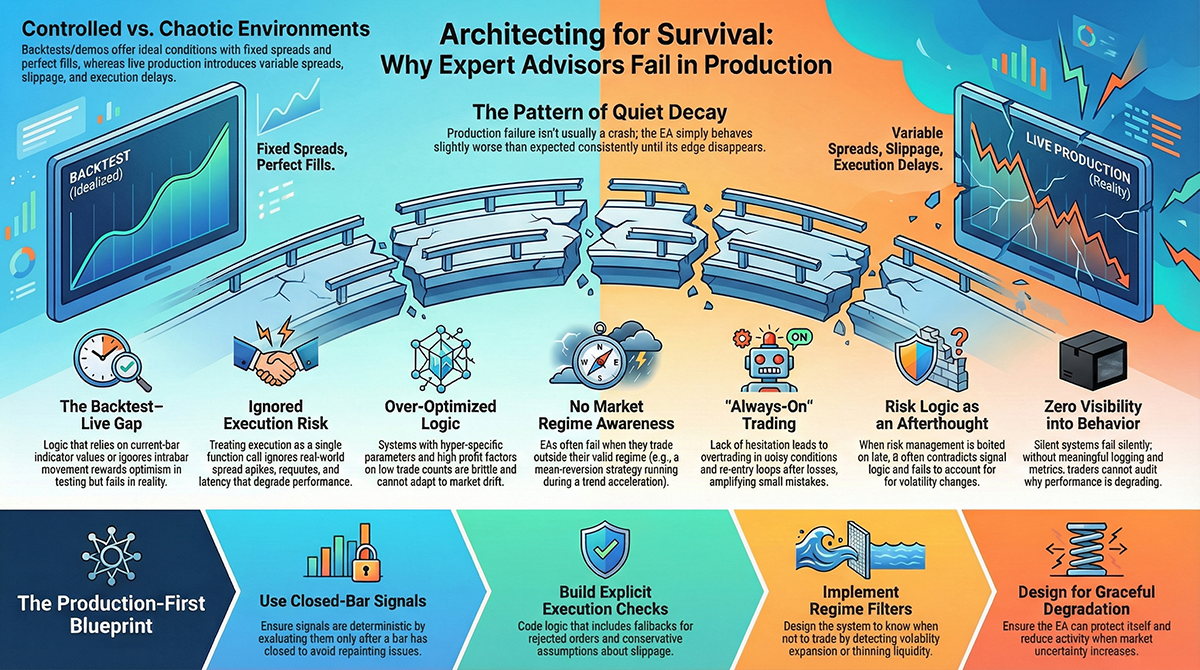
This article explains why EAs that look great in testing quietly fail in live trading, what “production failure” really means for MT5 systems, and how to code around these issues instead of reacting to them after damage is done.
Production Is a Different Environment
Backtests and demos are controlled environments.
Live trading is not.
In production, your EA faces:
- Variable spreads
- Slippage and partial fills
- Execution delays
- Broker rule changes
- Market behavior that was never in your data
An EA that assumes ideal conditions is already fragile.
Production failure usually means the EA behaves slightly worse than expected, consistently, until the edge disappears.
Failure #1: The Backtest–Live Gap
The most dangerous EA failure is not a broken one.
It is an EA that behaves differently live than it did in backtesting.
Common causes include:
- Using current-bar indicator values
- Ignoring intrabar price movement
- Assuming fixed spreads
- Perfect order fills
Backtests reward optimism.
Live trading punishes it.
If your EA logic does not explicitly define when and how signals are evaluated, you are testing a different system than you deploy.
Failure #2: Execution Risk Is Ignored
Many EAs treat execution as a single function call.
In reality, execution is a process with failure modes.
Live execution introduces:
- Spread spikes at entry
- Rejected or requoted orders
- Stop-level violations
- Latency between signal and fill
Each of these slightly degrades performance.
Together, they can erase a thin edge completely.
Production-ready EAs assume execution will be imperfect and design logic that remains profitable despite it.
Failure #3: Over-Optimized Logic
Many EAs are optimized for the past, not for reality.
Symptoms of over-optimization:
- Very specific parameter values
- High profit factor with low trade count
- Sensitivity to small parameter changes
These EAs look impressive in reports.
In production, they are brittle.
Markets drift. Edges decay. Regimes shift.
Optimized-to-perfection systems cannot adapt.
Failure #4: No Market Regime Awareness
Markets do not behave consistently.
Yet many EAs assume they do.
A strategy built for:
- Low volatility
- Mean reversion
- Session-specific behavior
Will fail quietly when:
- Volatility expands
- Trends accelerate
- Liquidity thins
The EA is not broken.
It is simply trading outside its valid regime.
Production systems must know when not to trade.
Failure #5: Always-On Trading
Many EAs are coded to trade whenever conditions are met.
There is no concept of hesitation.
This leads to:
- Overtrading in noisy conditions
- Re-entry loops after losses
- Excess exposure during instability
Always-on logic amplifies small mistakes.
Production-ready EAs reduce activity when uncertainty increases.
Failure #6: Risk Logic Is an Afterthought
Risk management is often bolted onto EAs late in development.
This creates contradictions:
- Signal logic expects fast exits, risk logic does not
- Position sizing ignores volatility changes
- Drawdown behavior becomes unpredictable
In production, risk logic defines survival.
Signal quality defines upside.
If risk logic is fragile, production failure is inevitable.
Failure #7: No Visibility Into Live Behavior
When performance degrades, many traders cannot explain why.
The EA offers no insight.
Without meaningful logging and metrics:
- Behavior cannot be audited
- Execution issues go unnoticed
- Fixes become guesswork
Silent systems fail silently.
How to Code Around Production Failure
Production survival is not about prediction.
It is about design.
Robust EAs share common traits:
- Closed-bar, deterministic signals
- Explicit execution checks and fallbacks
- Conservative assumptions about spreads and slippage
- Regime-aware trade filters
- Graceful degradation under stress
They trade less, but better.
A Production-First EA Mindset
Instead of asking:
“How good does this look in backtest?”
Ask:
- What assumptions does this logic make?
- What happens when those assumptions fail?
- Can the EA protect itself?
Production is where assumptions go to die.
Good EAs plan for that.
Why Production Failure Feels So Confusing
Because nothing is obviously wrong.
The EA trades. The code runs. The losses are gradual.
This makes it tempting to tweak parameters endlessly instead of addressing design flaws.
Production failure is rarely fixed by optimization.
It is fixed by architecture.
Backtests Build Hope, Production Tests Truth
Most EAs fail not because the developer lacked intelligence, but because they trusted testing environments too much.
At 1kPips, we believe durable EA performance comes from respecting the difference between simulated markets and real ones.
Design for production first, and your EA finally has a chance to earn its keep.
Comments