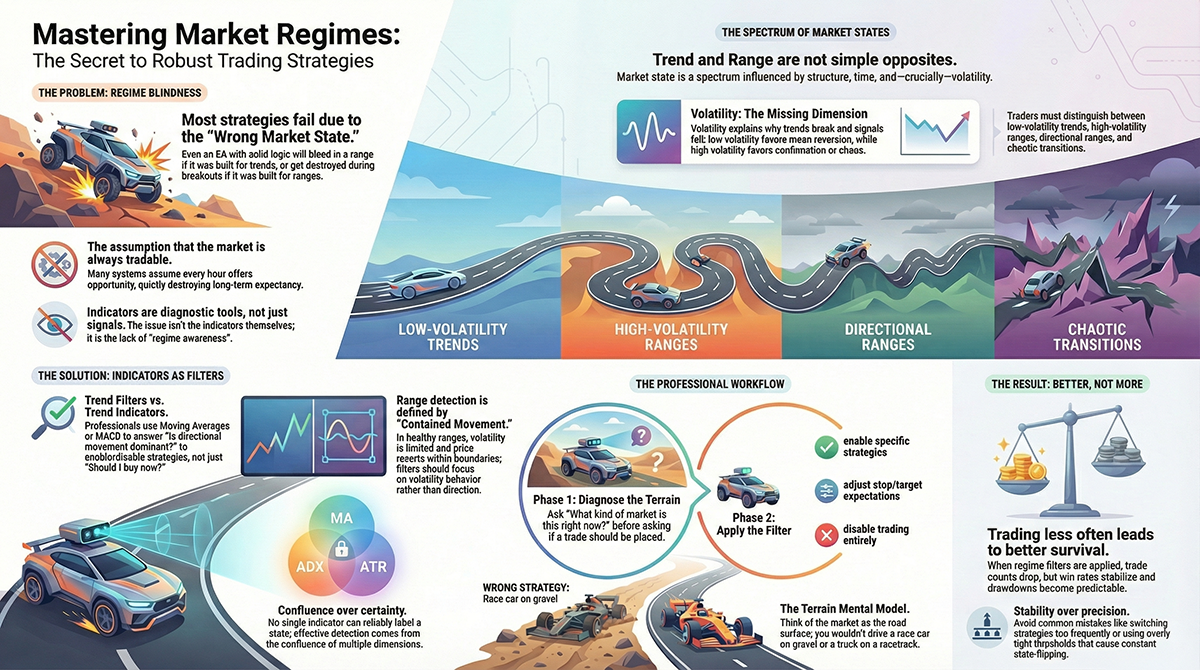
Most trading strategies don’t fail because the entry is wrong.
They fail because they are trading the wrong market state.
At 1kPips, this is one of the most common problems we see when reviewing EAs with solid logic but unstable performance. A strategy designed for trends bleeds in ranges. A range strategy gets destroyed during breakouts.
The issue is not indicators.
The issue is regime awareness.
This article explains how to think about trend vs range, why most traders misidentify market state, and how indicators should be used as filters rather than signals when building robust trading systems.
Why Market Regime Comes Before Strategy
Markets do not behave the same way all the time.
Sometimes price trends smoothly.
Sometimes it oscillates with no direction.
Sometimes volatility explodes and nothing works.
A strategy is only valid inside the regime it was designed for.
If you ignore this, even a good system becomes fragile.
The Core Mistake: Assuming the Market Is Always Tradable
Many EAs implicitly assume:
- Every hour offers opportunity
- Indicators always mean the same thing
- Signals are universally valid
This assumption quietly destroys expectancy.
Professional systems ask a different question first:
“What kind of market is this right now?”
Only after that do they ask:
“Does my strategy belong here?”
Trend and Range Are Not Opposites
A common misconception is that markets are either trending or ranging.
In reality, market state is a spectrum influenced by volatility, structure, and time.
You can have:
- Low-volatility trends
- High-volatility ranges
- Directional ranges
- Chaotic transitions
Indicators don’t label regimes for you. They provide clues.
Trend Indicators Are Not Trend Filters
This distinction matters.
Many traders use moving averages or MACD as entry signals.
Professionals use them as filters.
A trend filter answers:
“Is directional movement dominant?”
It does not answer:
“Should I buy now?”
Moving averages, EMA slopes, and higher-timeframe bias work best when used to enable or disable strategies, not to time trades.
Range Detection Is Mostly About Volatility
Ranges are not defined by flat price.
They are defined by contained movement.
In healthy ranges:
- Volatility is limited
- Price reverts within boundaries
- Moves lose momentum quickly
Indicators that help identify ranges focus on volatility behavior, not direction.
This is why range filters often outperform directional indicators for regime detection.
Volatility: The Missing Dimension
Trend vs range without volatility is incomplete.
Volatility explains:
- Why trends break
- Why ranges expand
- Why signals suddenly fail
Low volatility favors mean reversion.
High volatility favors continuation or chaos.
Ignoring volatility leads to trading yesterday’s logic in today’s market.
Why Single Indicators Fail at Regime Detection
No single indicator can reliably label market state.
Each indicator sees only one dimension:
- Moving averages see direction
- ADX sees movement strength
- ATR sees volatility magnitude
Effective regime detection comes from confluence, not confirmation.
The goal is not certainty. The goal is avoiding the worst conditions.
How Professional EAs Use Regime Filters
In robust EA design, regime filters are used to:
- Enable specific strategies
- Disable trading entirely
- Adjust stop and target expectations
They are rarely used to generate trades directly.
This reduces overtrading and protects capital during unfavorable conditions.
Common Regime Detection Mistakes
- Switching strategies too frequently
- Using tight thresholds that flip states constantly
- Assuming regime detection must be precise
- Optimizing regime parameters too aggressively
Regime detection should be stable, even if it is imperfect.
A Practical Mental Model
Think of market regime like terrain.
You wouldn’t drive a race car on gravel or a truck on a racetrack.
Indicators help you see the road surface.
Your strategy decides whether to drive.
Why Fewer Trades Often Mean Better Trades
When regime filters are applied correctly:
- Trade count drops
- Win rate stabilizes
- Drawdowns become more predictable
This feels uncomfortable to many traders.
But most profitable EAs survive by trading less, not more.
Indicators Describe, Strategies Decide
Indicators are not trading systems.
They are diagnostic tools.
Understanding trend vs range is about context, not prediction.
At 1kPips, we believe long-term performance comes from knowing when not to trade as much as knowing how to trade.
Get the market state right, and your strategy finally gets a fair chance to work.
Comments