Overtrading does not look dangerous at first.
In fact, it often feels productive.
More trades. More activity. More chances to win.
But when we analyze real trading data, especially from automated systems and high-frequency EAs, one pattern shows up again and again:
Overtrading quietly destroys performance long before traders realize what is happening.
At 1kPips, where we focus on signals, execution, and verified EA results, overtrading is one of the most common reasons otherwise solid strategies underperform.
This article explores the psychology behind overtrading, why both manual and EA traders fall into it, and how to stop it before it damages your account.
::contentReference[oaicite:0]{index=0}
1. What Overtrading Really Is (and What It Is Not)
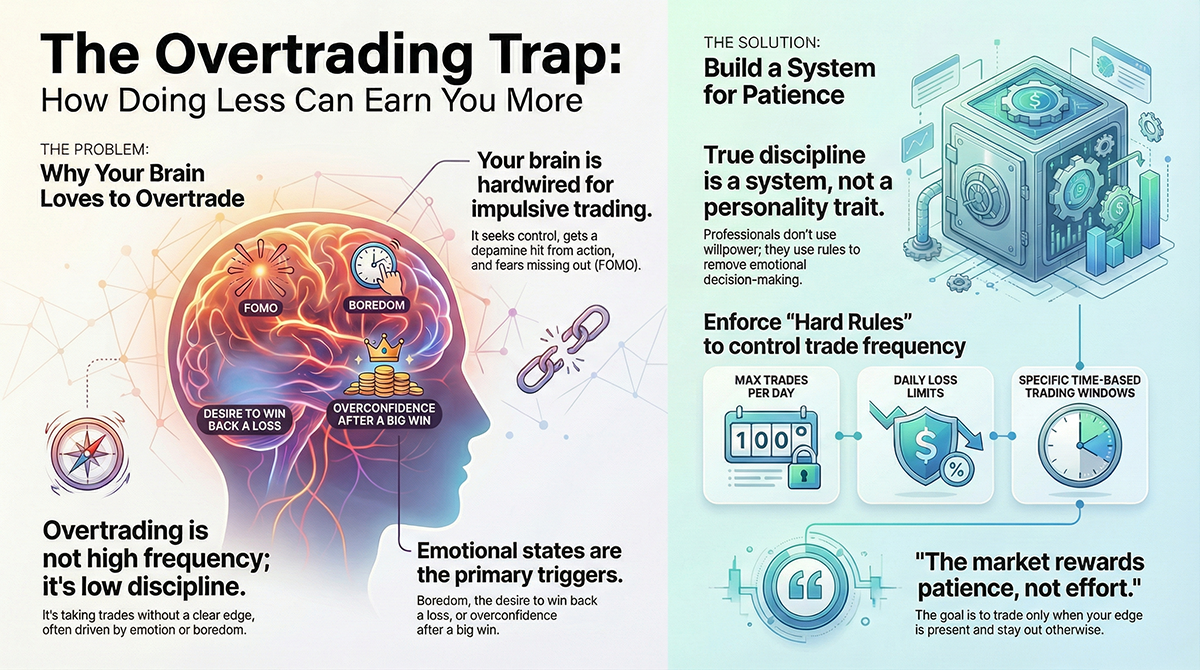
Overtrading is not simply trading a lot.
Some strategies require high frequency.
Overtrading happens when:
- Trades are taken without a clear edge
- Frequency increases after losses or boredom
- Rules are bent “just this once”
In other words, overtrading is not about quantity.
It is about loss of discipline.
2. Why the Human Brain Loves Overtrading
Overtrading is deeply psychological.
It is driven by how the human brain reacts to uncertainty, reward, and control.
The Illusion of Control
When markets move without you, it feels uncomfortable.
Placing a trade restores a sense of control, even if the trade has no real edge.
Action feels better than waiting.
Dopamine and Trade Execution
Every trade triggers anticipation.
Win or lose, the act itself creates stimulation.
This is why overtrading often feels exciting, not stressful, at first.
Fear of Missing Out
Markets never stop moving.
Without rules, every candle looks like an opportunity.
This fear pushes traders to click when they should be waiting.
3. Overtrading in EA Trading: A Hidden Problem
Many traders assume overtrading is only a manual trading issue.
It is not.
In EA trading, overtrading appears in different forms:
- Too many indicators triggering entries
- No session or volatility filters
- Trading during statistically weak hours
- Multiple EAs overlapping the same market logic
The EA is not emotional.
The overtrading behavior was coded into it.
4. Trade Frequency vs Trade Quality
One of the most common misconceptions is:
More trades mean more profit.
In reality, most strategies have a limited number of high-quality opportunities.
When you increase frequency beyond that limit:
- Average trade quality drops
- Transaction costs increase
- Drawdowns deepen
Many EAs improve performance simply by trading less.
Not by trading smarter. By trading less.
5. Emotional Triggers That Cause Overtrading
After a Loss
Losses create discomfort.
The fastest way to remove that feeling is to enter another trade.
This is how small losses turn into large drawdowns.
After a Win
Winning increases confidence.
Confidence lowers caution.
This is when traders loosen rules and increase frequency.
Boredom
Markets are quiet more often than traders expect.
Boredom is one of the strongest overtrading triggers.
6. The Long-Term Cost of Overtrading
Overtrading rarely causes instant failure.
It causes slow decay.
- Higher commission and spread costs
- Lower average R-multiple
- Longer drawdown periods
This makes overtrading especially dangerous.
By the time traders notice the damage, performance has already degraded.
7. How Professionals Control Trade Frequency
Professional traders do not rely on willpower.
They rely on structure.
Hard Rules
- Maximum trades per session
- Daily loss limits
- Time-based trading windows
Predefined Conditions
- Only trade when volatility is within range
- Only trade after confirmation, not prediction
- No discretionary overrides
For EA traders, these controls must be coded explicitly.
8. Discipline Is a System, Not a Personality Trait
Many traders believe discipline is about being mentally strong.
Professionals know better.
Discipline is about removing decisions at the wrong time.
The best systems:
- Prevent trading during emotional states
- Reduce opportunity overload
- Force patience through design
If discipline relies on constant self-control, it will eventually fail.
9. Practical Steps to Stop Overtrading
- Define maximum trades per day or session
- Log trades and review frequency, not just profit
- Accept that most time is spent waiting
- Measure performance per trade, not per day
In EA trading, removing just one unnecessary entry condition often improves results.
Fewer Trades, Better Results
Overtrading is not a strategy problem.
It is a psychological problem disguised as activity.
The market rewards patience, not effort.
Whether you trade manually or with EAs, the goal is the same:
Trade only when your edge is present, and stay out the rest of the time.
Sometimes, the most profitable trade is the one you never take.
Comments