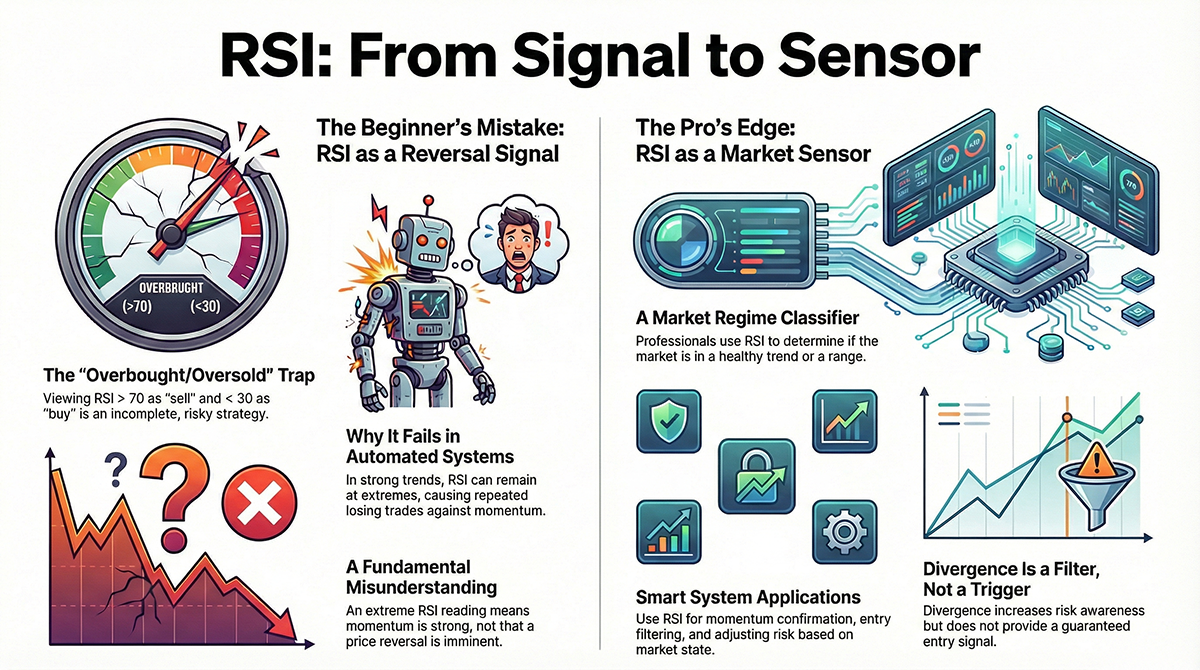
Why system traders treat RSI as a state detector, not a buy/sell button.
The RSI indicator is one of the most misunderstood tools in technical analysis. For discretionary traders, it often becomes a simple rule: above 70, sell. below 30, buy.
For system traders and EA developers, that mindset is not only incomplete, it is dangerous. RSI is not a signal generator by default. It is a market condition sensor.
In this article, we break RSI out of its beginner box and show how it is actually used in professional-grade automated strategies.
Why Overbought and Oversold Fail in EAs
The first lesson every EA builder learns is simple: markets can stay irrational longer than your stop loss can survive.
In strong trends, RSI can sit above 70 or below 30 for days. A naive mean-reversion EA will keep firing trades straight into a trend.
This is why many “RSI EAs” look amazing in short backtests and collapse the moment market structure changes.
RSI does not mean price must reverse. It means momentum is strong.
RSI as Momentum Analysis
At its core, RSI measures the balance between recent gains and losses. That makes it a momentum oscillator, not a reversal indicator.
System traders often ask a different question:
- Is the market trending with strength
- Is momentum fading or accelerating
- Is price moving with effort or exhaustion
Practical EA usage:
- RSI staying between 40–80 often signals a healthy uptrend
- RSI staying between 20–60 often signals a healthy downtrend
- Repeated failure to reach prior RSI highs indicates weakening momentum
Instead of trading against RSI extremes, trend-following EAs often use RSI to confirm that momentum still exists.
Divergence: A Filter, Not a Trigger
RSI divergence is popular because it looks predictive. Price makes a higher high, RSI makes a lower high. It feels like a warning sign.
The problem is timing.
Divergences can persist for a long time. In strong markets, they often fail completely.
In EA design, divergence works best as a context filter:
- Reduce position size when divergence appears
- Disable breakout entries during divergence
- Prepare for regime change but do not trade blindly
The key rule: divergence increases risk awareness, not entry certainty.
RSI and Mean Reversion Done Right
Mean reversion strategies can work with RSI, but only in the right market environment.
Successful RSI-based mean reversion EAs usually include:
- Low volatility filters
- Range detection logic
- Time-of-day constraints
- Higher timeframe trend filters
In other words, RSI is never alone. It is part of a system that defines when mean reversion is statistically valid.
Without those filters, RSI reversion becomes disguised martingale.
How Professional EAs Actually Use RSI
On performance-focused EA desks, RSI is rarely visible on charts. It runs quietly in the background.
Typical uses include:
- Regime classification (trend vs range)
- Momentum confirmation for breakouts
- Entry suppression during extreme conditions
- Dynamic stop or take-profit adjustment
RSI does not say “buy” or “sell”. It says “this is the type of market you are trading right now”.
Key Takeaways for EA Traders
- RSI is a momentum indicator, not a reversal guarantee
- Overbought and oversold are market states, not signals
- Divergence works best as a risk filter
- Mean reversion with RSI requires strict environment control
If your EA logic starts with “RSI crossed 70 so sell”, you are building a fragile system.
If it starts with “what does RSI say about the market regime”, you are thinking like a system trader.
Comments