Most traders do not fail because they are always wrong.
They fail because, sooner or later, they encounter a sequence of losses they were never prepared to survive.
This is called risk of ruin.
At 1kPips, where we evaluate real EA performance and long-term equity curves, risk of ruin is one of the most important concepts traders rarely think about. It is also the quiet reason why most accounts eventually blow up, even when the strategy looks good on paper.
This article explains what risk of ruin really means, why it is unavoidable, and how professional and EA traders design systems to stay alive.
1. What Risk of Ruin Actually Means
Risk of ruin is the probability that your trading account will fall to a level where recovery is no longer possible.
That level might be:
- A margin call
- A forced stop of trading
- A psychological breaking point
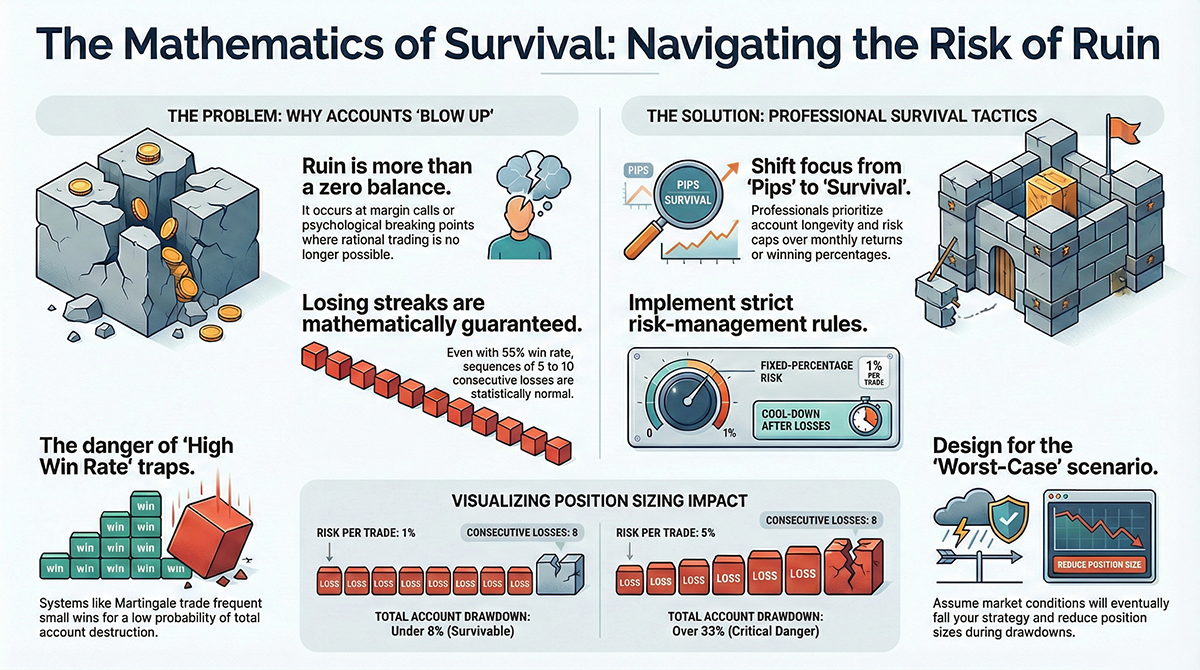
Ruin does not always mean zero balance.
For many traders, ruin happens much earlier, when drawdown becomes so deep that rational decision-making disappears.
The critical insight is this:
Even profitable strategies have a non-zero risk of ruin if risk is unmanaged.
2. Probability Is Ruthless and Impersonal
Markets do not care about how good your last trade was.
They operate on probability.
If your system has:
- Win rate below 100 percent
- Finite capital
- Non-zero risk per trade
Then losing streaks are not possible. They are guaranteed.
The only unknown is how long they will be.
Many traders backtest for a few months, see no major loss streaks, and assume safety.
Professionals assume the opposite:
If it can happen, it eventually will.
3. Loss Streaks Are the Real Enemy
Single losses do not kill accounts.
Loss streaks do.
Consider a strategy with a solid 55 percent win rate.
That still means:
- 45 percent of trades are losers
- Five, six, or even ten losses in a row are statistically normal
The question is not whether your system will experience a long losing streak.
The question is:
Can your account survive it?
Most accounts cannot, because risk per trade is too high.
4. Why Traders Underestimate Risk of Ruin
There are several common psychological traps.
Short-Term Thinking
Traders evaluate systems over weeks instead of years.
Probability needs time to reveal its extremes.
Overconfidence From Early Wins
A strong start increases risk-taking.
This often happens right before the first major drawdown.
Confusing Win Rate With Safety
High win rate feels safe.
But win rate alone says nothing about ruin.
A system with 80 percent wins can still blow up faster than one with 45 percent wins if risk is poorly controlled.
5. Risk of Ruin and Position Size
Risk of ruin is highly sensitive to position sizing.
Small changes in risk per trade create massive differences in survival probability.
For example:
- Risk 5 percent per trade
- Experience eight losses in a row
- Account drawdown exceeds 33 percent
Now compare:
- Risk 1 percent per trade
- Eight losses in a row
- Account drawdown stays under 8 percent
Both scenarios are realistic.
One destroys confidence and margin.
The other is survivable.
6. Account Survival Is the Primary Objective
Retail traders often focus on:
- Monthly return
- Pips gained
- Winning percentage
Professional traders focus on one thing first:
Account survival.
If the account survives, opportunity continues.
If it does not, the strategy no longer matters.
This is why professional EAs are designed with:
- Strict risk caps
- Daily and weekly loss limits
- Automatic cool-down rules
7. Why Martingale and Grid Systems Are Vulnerable
Many popular retail EAs rely on:
- Increasing size after losses
- Averaging down without limits
These systems often show beautiful equity curves.
Until they do not.
From a risk-of-ruin perspective, these approaches are dangerous because:
- Risk grows exponentially
- Loss streaks accelerate exposure
- Ruin is delayed, not avoided
They trade a high probability of small wins for a low probability of total destruction.
8. How Professionals Reduce Risk of Ruin
Professionals cannot eliminate risk of ruin.
They reduce it to acceptable levels.
Common Professional Practices
- Risking a small fixed percentage per trade
- Assuming worst-case loss streaks in design
- Reducing size during drawdowns
- Diversifying strategies and sessions
They accept slower growth in exchange for longevity.
9. EA Traders: A Hard Truth
If your EA requires:
- Perfect market conditions
- No long losing streaks
- Manual intervention to survive
Then its risk of ruin is high.
Markets eventually deliver the scenario you did not plan for.
EA trading rewards those who plan for boredom, not excitement.
Most Traders Fail Because They Ignore the Inevitable
Risk of ruin is not dramatic.
It is quiet.
It waits patiently for enough losses, enough leverage, and enough time.
The traders who survive are not the smartest or the most aggressive.
They are the ones who respect probability, control risk, and design for survival first.
In trading, staying alive is the real edge.
Comments