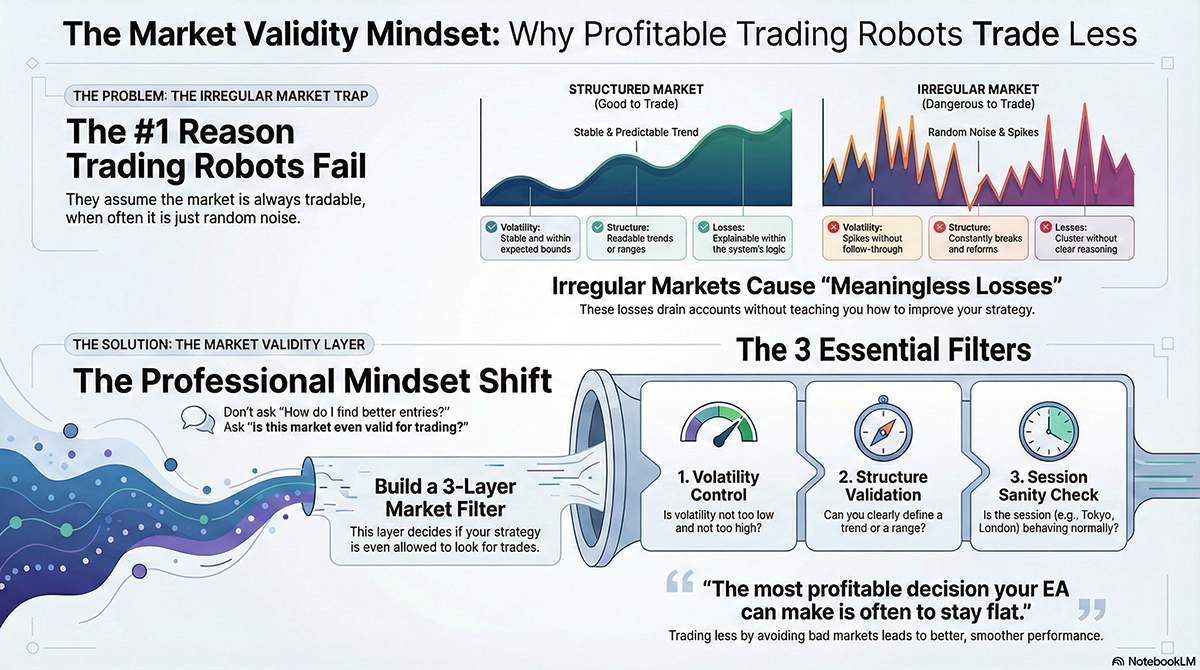
The difference between a losing EA and a profitable one is often not the entry logic. It is the ability to stay out of the market when conditions are not worth trading.
The hidden assumption that breaks most trading systems
Many EAs are built on a silent assumption: the market is always tradable. As long as price is moving and indicators are updating, the system believes an opportunity must exist. This assumption is false. Markets move every day, but they are not always offering a repeatable edge. Sometimes price action is structured. Sometimes it is noise. The job of a professional trading system is not to trade constantly. It is to trade only when the market behavior matches the conditions the system was designed for.
Structured markets vs irregular markets
Every profitable strategy depends on structure. Trend systems rely on directional persistence. Range systems rely on bounded movement and reversion. Scalp systems rely on predictable micro-volatility. An irregular market is a state where none of those assumptions hold. Price still moves, but movement is inconsistent, unreliable, and hostile to systematic execution.
Characteristics of a structured market
- Volatility is stable and within expected bounds
- Swing structure is readable
- Session behavior matches historical tendencies
- Losses are explainable within the system logic
Characteristics of an irregular market
- Volatility spikes without follow-through
- Structure constantly breaks and reforms
- Session roles blur or invert
- Losses cluster without clear reasoning
Why irregular markets are deadly for EAs
Human traders can sometimes “feel” that conditions are wrong and step aside. EAs cannot. They will keep executing rules unless explicitly told not to.
In irregular markets:
- Trend systems enter breakouts that immediately fail
- Range systems fade levels that no longer hold
- Scalpers get chopped by spread and slippage
Even worse, these losses feel random. They do not teach you how to improve the strategy, because the strategy itself was never meant to operate in that environment. This is where many traders start overfitting. They try to “fix” entries instead of admitting the market was untradable.
The mindset shift: from signal generation to market validation
Most EA builders ask: “How do I find better entries?”
Professional system designers ask: “Is this market valid for trading at all?”
This single shift changes everything. You stop thinking in terms of prediction and start thinking in terms of permission. The market must earn the right to be traded.
The Market Validity Layer: your EA’s most important component
A Market Validity Layer sits above all strategies. It does not care about entries. It decides whether any strategy is allowed to operate.
Filter 1: Volatility regime control
Every strategy has a volatility range where it performs best. Below that range, price does not move enough. Above it, noise overwhelms structure.
Using ATR or session-based volatility:
- Define a minimum tradable volatility
- Define a maximum acceptable volatility
- Disable trading outside this band
This alone can remove a large portion of unnecessary losses.
Filter 2: Market structure validation
Structure answers a simple question: Can you describe what the market is doing?
If you cannot clearly define:
- a trend (HH/HL or LL/LH), or
- a range with repeated boundaries
then the market is not offering a usable pattern. No description means no trade.
Filter 3: Session sanity check
Session-based trading works because sessions have behavior. Tokyo compresses. London expands. New York re-prices. When a session stops behaving like itself, your historical edge disappears. A Tokyo session that behaves like a news-driven New York open should not be traded as Tokyo.
Accepting losses vs avoiding meaningless losses
Losses are not the enemy. Every valid strategy has expected losses. The real damage comes from meaningless losses: trades taken when no valid structure existed in the first place.
These losses:
- Cluster unexpectedly
- Increase drawdown without increasing knowledge
- Create emotional and analytical confusion
A good EA accepts losses. A great EA avoids meaningless participation.
Building a portfolio that respects market conditions
The natural extension of market validation is portfolio control. Instead of one strategy trading all conditions, you create a matrix:
- Session: Tokyo, London, New York
- Regime: Range, Trend, Volatile
- Strategy: specialized for that combination
When conditions change, strategies are enabled or disabled. The system adapts without curve fitting.
Trading less is often trading better
If your EA is always active, it is probably overtrading. Markets reward patience, not constant participation. The most profitable decision your EA can make is often to stay flat. Once you focus on avoiding irregular markets, performance metrics improve naturally: drawdown stabilizes, equity curves smooth out, and results become easier to scale. This is not about trading smarter entries. It is about trading only when the market deserves your risk.
Comments