Few debates in trading are as persistent as this one:
Price action traders vs indicator traders.
One side says indicators lag and hide reality.
The other says price action is subjective and vague.
At 1kPips, we think this debate misses the real issue entirely.
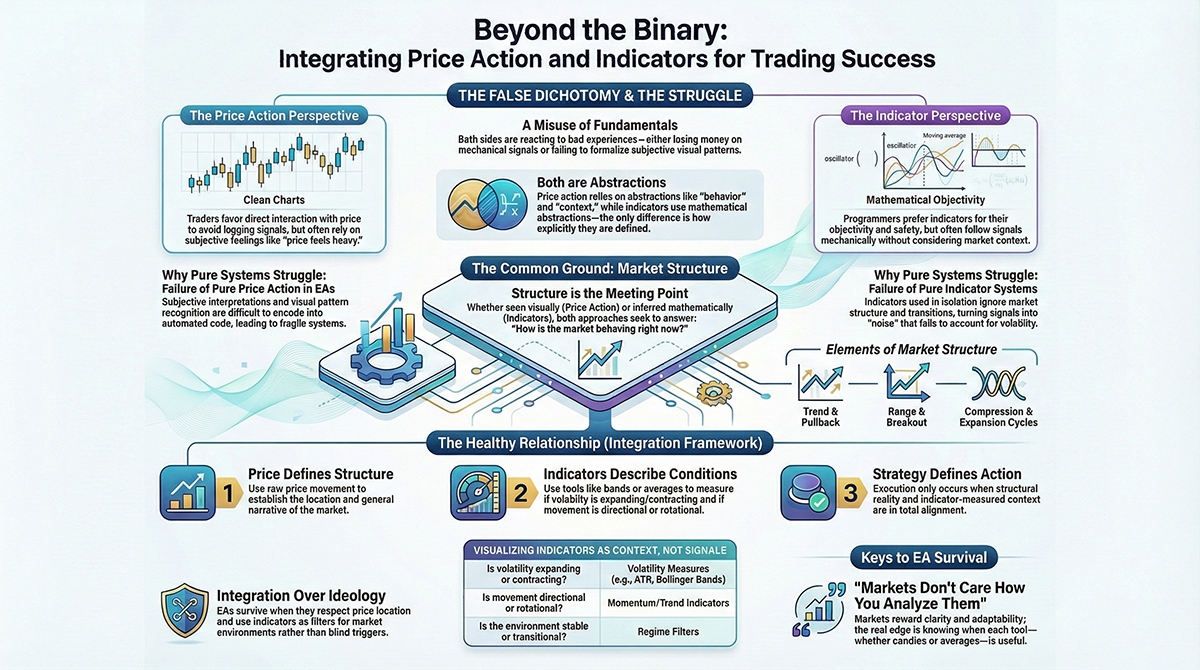
Price action and indicators are not enemies. Treating them as opposites is a false dichotomy that leads traders and EA developers into unnecessary confusion, fragile systems, and ideological arguments instead of better performance.
This article explains why the price action vs indicators debate exists, why it is misleading, and how professional systems actually combine structure, behavior, and indicator context without turning trading into a philosophy war.
Where the Debate Comes From
The debate usually starts with a bad experience.
A trader follows indicator signals mechanically and loses money.
They then discover price action:
- Clean charts
- No lagging lines
- Direct interaction with price
It feels more real.
On the other side, programmers and systematic traders encounter price action descriptions that sound like:
- “It looks weak here”
- “Price feels heavy”
- “This candle tells a story”
To them, indicators feel safer and more objective.
Both sides are reacting to misuse, not fundamentals.
Price Action Is Not Indicator-Free
This is the first misconception.
Price action traders are not trading raw price in a vacuum.
They rely on:
- Structure (highs, lows, ranges)
- Context (trend, consolidation)
- Behavior (reaction, follow-through)
These are abstractions.
Indicators are also abstractions.
The difference is not what is used, but how explicitly it is defined.
Indicators Are Not Signal Generators by Default
The second misconception is that indicators exist to give buy and sell signals.
That is a usage choice, not a requirement.
Indicators can describe:
- Volatility
- Momentum
- Market regime
- Relative position
When indicators are used as context instead of triggers, they stop fighting price action and start supporting it.
Structure Is the Common Ground
Structure is where price action and indicators meet.
Market structure includes:
- Trends and pullbacks
- Ranges and breakouts
- Compression and expansion
Price action traders see this visually.
Indicator-based systems often infer it mathematically.
Both approaches are trying to answer the same question:
“How is the market behaving right now?”
Why Pure Price Action Struggles in Automation
For discretionary trading, price action can work well.
For EAs, it often breaks down.
Why:
- Subjective interpretations are hard to formalize
- Visual pattern recognition is difficult to encode
- Different traders define structure differently
Indicators help translate price behavior into consistent rules.
This is not a weakness. It is a requirement for systematic trading.
Why Pure Indicator Systems Also Fail
Indicator-only systems often fail for the opposite reason.
They ignore:
- Where price is relative to structure
- How the market transitioned into the current state
- Whether volatility supports the signal
A signal without context is noise.
Price action provides the narrative. Indicators provide measurement.
Indicators as Context, Not Authority
The healthiest relationship between price action and indicators looks like this:
- Price defines structure
- Indicators describe conditions
- Strategy defines action
Indicators should answer questions such as:
- Is volatility expanding or contracting?
- Is movement directional or rotational?
- Is this environment stable or transitional?
They should not override obvious structural reality.
Why This Matters for EA Performance
EAs fail when they:
- Trade indicators blindly
- Ignore market structure
- Assume signals mean the same thing everywhere
EAs survive when they:
- Use indicators to filter environments
- Respect price location and behavior
- Trade only when structure and context align
This is not price action vs indicators.
It is integration vs ideology.
A Practical Example Mindset
Instead of asking:
“Should I trust price action or indicators?”
Ask:
- What is the current market structure?
- What conditions does volatility suggest?
- Does my strategy belong here?
These questions work for discretionary traders and automated systems alike.
Why the Debate Persists
Because simplicity is comforting.
Choosing a side feels easier than learning how pieces fit together.
But markets are not ideological.
They reward clarity, adaptability, and realism.
Markets Don’t Care How You Analyze Them
Price action and indicators are languages.
Markets respond to behavior, not belief systems.
At 1kPips, we focus on understanding how markets move and building systems that respect that behavior, regardless of whether the insight comes from candles, bands, averages, or volatility measures.
The real edge is not choosing sides.
It is knowing when each tool is useful and when it is not.
Comments