Every trader wants a better entry. A smarter signal. A cleaner indicator. But when you analyze real EA performance data, one thing becomes painfully clear:
Position sizing matters more than your strategy.
At 1kPips, we focus on automated trading, signals, and verified performance. From that angle, position sizing is not a small detail. It is the engine that determines whether your account survives or explodes. This article breaks down position sizing in forex trading, why it works, and why it is the only formula that truly matters for EA traders.
1. Why Most Traders Get Position Sizing Wrong
Ask traders how they choose lot size and you will often hear:
- “I use 0.1 lots per trade.”
- “I increase size when I feel confident.”
- “I just use the same lot every time.”
This approach ignores one critical fact:
Your account balance is always changing.
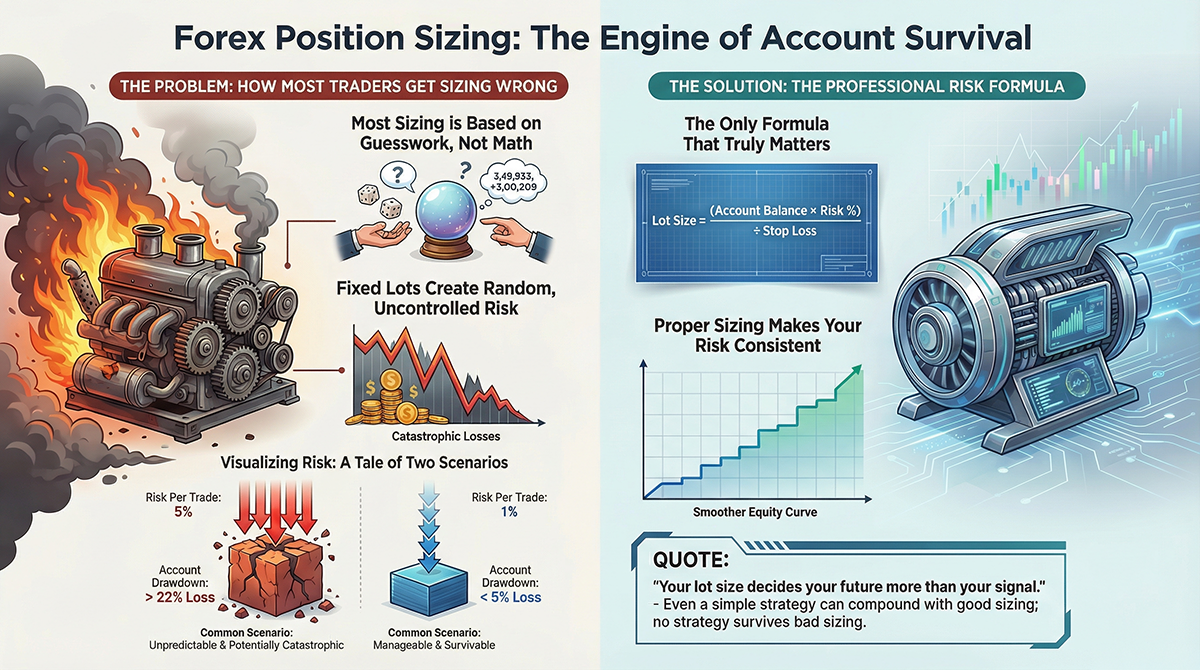
Fixed lot sizing means your risk is random. Sometimes it is small. Sometimes it is catastrophic. Professional traders and profitable EAs do not think in lots. They think in risk.
2. Position Sizing Is Risk Control in Disguise
Position sizing answers a single, powerful question:
How much of my account am I willing to lose if this trade fails?
Everything else comes from that.
This is why position sizing is inseparable from risk management:
- Lot size controls loss size
- Loss size controls drawdown
- Drawdown controls survival
If your EA blows up, it is almost never because the entry was wrong once. It is because losses were allowed to grow unchecked.
3. The Only Formula That Actually Matters
Forget complex indicators for a moment.
This is the position sizing formula that matters:
Lot Size = (Account Balance × Risk %) ÷ Stop Loss
That is it. Everything else is detail.
What This Formula Does
- Risk is fixed as a percentage of the account
- Loss size is predictable
- Account volatility is reduced
Whether you scalp M1 or swing H1, this formula keeps your risk consistent.
4. Account Risk: Small Numbers, Big Impact
Many traders underestimate how powerful small risk values are.
Consider this:
- Risk 5 percent per trade
- Lose 5 trades in a row
- Account down more than 22 percent
Now compare that with:
- Risk 1 percent per trade
- Lose 5 trades in a row
- Account down less than 5 percent
Both scenarios happen regularly in real markets. One destroys confidence and margin. The other is just noise. This is why many serious EA traders cap risk between 0.25 and 1 percent per trade.
5. Trade Sizing Across Different Strategies
Not all trades deserve the same size.
Scalping EAs
- Higher frequency
- Lower per-trade risk
- Tighter drawdown control
Swing or Trend EAs
- Lower frequency
- Wider stop losses
- Same percentage risk, different lot size
Good EAs adapt trade size to stop distance, not market emotion.
6. Why Position Sizing Beats Entry Optimization
You can improve an entry by a few percent. You can improve position sizing by orders of magnitude.
Better sizing means:
- Smoother equity curve
- Lower maximum drawdown
- Higher long-term survivability
Many traders discover that an average strategy becomes profitable once sizing is fixed. Almost no strategy survives bad sizing.
7. EA Traders: Common Position Sizing Mistakes
- Martingale without strict caps
- Grid systems with unlimited exposure
- Ignoring correlated pairs
- Using fixed lots across different balances
These mistakes do not fail immediately. They fail eventually.
Position Sizing Is Not Optional
Entries feel smart. Indicators feel powerful. Position sizing feels boring. But boring is exactly what keeps your account alive. If you remember only one thing from this article, let it be this:
Your lot size decides your future more than your signal.
Get position sizing right, and even simple strategies can compound. Get it wrong, and no strategy will save you.
Comments