Moving Averages Explained for System Traders
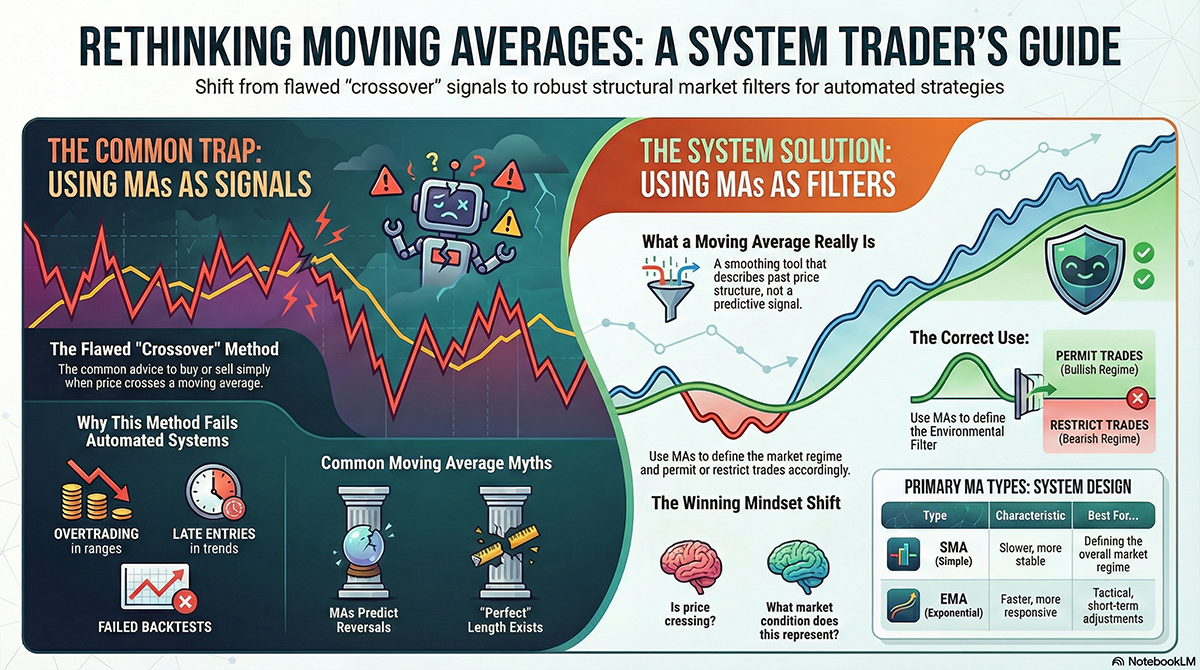
Moving averages are probably the first indicator you ever used. They are also one of the most misunderstood tools in system trading. For discretionary traders, moving averages often become visual comfort. For EA traders, they must become something else entirely: a structural filter. In this article, we explain moving averages from a system trader’s point of view. No magic. No crossover hype. Just performance-driven logic.
The Problem With How Moving Averages Are Taught
Most trading education introduces moving averages like this:
“When price crosses the moving average, buy. When it crosses back, sell.”
This approach fails for one simple reason: markets do not move in clean lines.
For EAs, this leads to:
- Overtrading in ranging markets
- Late entries in strong trends
- Beautiful backtests that collapse live
The issue is not the moving average. The issue is how it is used.
What a Moving Average Really Is
A moving average is not a trendline. It is not support or resistance. It is not a prediction tool.
A moving average is:
- A rolling summary of past prices
- A smoothing function
- A time-based filter
Every moving average answers one question:
“Where has price been, on average, over the last N periods?”
That’s it. Everything else is interpretation.
SMA vs EMA: The Difference That Actually Matters
System traders often debate SMA versus EMA as if one is superior. In reality, they serve slightly different purposes.
Simple Moving Average (SMA)
SMA treats all past prices equally.
- More stable
- Slower to react
- Better for regime definition
SMAs are often useful for higher-timeframe filters in EAs.
Exponential Moving Average (EMA)
EMA gives more weight to recent prices.
- Faster response
- More sensitive to noise
- Better for tactical adjustments
EMAs react faster, but they also lie faster.
Why Moving Averages Lag (And Why That’s Good)
Lag is often treated as a weakness. For system traders, it is a safety mechanism.
Lag means:
- Fewer false reactions
- More stable signals
- Less emotional noise
In EA trading, consistency beats early entry. A late entry with controlled risk often outperforms a perfect top or bottom.
Moving Averages as Trend Filters
The most effective use of moving averages in systems is not entry. It is filtering.
Examples:
- Only allow longs when price is above a long-term MA
- Disable trading when price oscillates around the MA
- Switch strategy logic based on MA slope
In other words: the moving average defines the environment.
Why Crossovers Rarely Work in Isolation
MA crossovers are simple, visual, and mostly unreliable on their own.
They fail because:
- They trigger late
- They whipsaw in ranges
- They ignore volatility context
In EA systems, crossovers can still be useful — but only as confirmation, never as the core signal.
How 1kPips Uses Moving Averages
At 1kPips, moving averages are never traded directly.
They are used to:
- Classify market regime
- Restrict signal execution
- Align trades with higher-timeframe bias
A moving average does not tell us to trade. It tells us when not to.
Common Moving Average Myths
- The perfect MA length exists
- Shorter MAs are always better
- MAs predict reversals
- More MAs mean better accuracy
Moving averages do not predict. They describe structure.
The System Trader Mindset
A discretionary trader asks:
“Is price crossing the moving average?”
A system trader asks:
“What market condition does this moving average represent?”
That difference defines long-term performance. Moving averages are boring. And that is exactly why they work. They remove emotion, reduce noise, and impose structure — three things every EA needs. Use moving averages to filter. Use logic to trade. That is how system traders win.
Comments