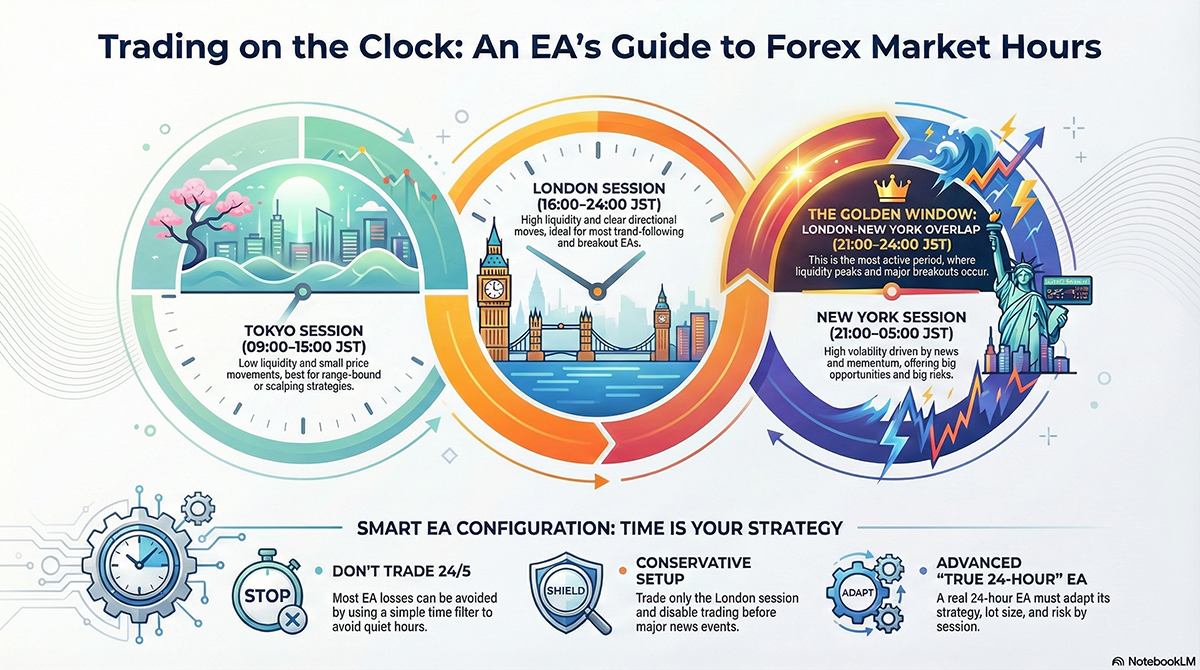
Forex runs 24 hours a day, five days a week. But anyone who has traded seriously—especially with an EA—knows this truth: not all hours are worth trading.
Forex Is Open 24 Hours, But the Market Is Not the Same
In theory, Forex never sleeps. In practice, the market changes its personality depending on who is trading, how much volume is flowing, and what kind of information is being priced in. Many losing EAs fail not because the logic is bad, but because they trade at the wrong time. Understanding market hours is not optional—it is part of the strategy.
Main Forex Trading Sessions (JST)
Tokyo Session (09:00–15:00 JST)
Market Character:
- Low to medium liquidity
- Small price movements
- Range-bound behavior
Active Pairs:
- USD/JPY
- EUR/JPY
EA Suitability:
- Range or mean-reversion strategies
- Very short-term scalping
Trend-following EAs usually struggle during Tokyo hours. Breakouts often fail, and profits are limited. For many systems, doing nothing is the best trade.
London Session (16:00–24:00 JST)
Market Character:
- High liquidity
- Clear directional moves
- Stable spreads
Active Pairs:
- EUR/USD
- GBP/USD
- EUR/GBP
EA Suitability:
- Trend-following strategies
- Breakout systems
This is where most profitable EAs do their real work. If you must choose only one session to trade, London is usually the answer.
New York Session (21:00–05:00 JST)
Market Character:
- High volatility
- Strong momentum
- Frequent economic news
Active Pairs:
- USD-based pairs
- EUR/USD
- GBP/USD
EA Suitability:
- Momentum strategies
- Post-news continuation systems
This session offers big opportunities—but also big risks. Without news filters and strict risk control, an EA can lose in minutes what it earned all week.
London–New York Overlap (21:00–24:00 JST)
This is the most active period in the Forex market. Liquidity peaks, trends accelerate, and real breakouts happen.
For well-designed EAs, this is the golden window. For poorly designed ones, it is the fastest way to blow an account.
Your EA Should Not Trade 24 Hours
Running an EA 24/5 sounds ideal. In reality, it often means:
- Overtrading during quiet hours
- Spread losses in low-liquidity markets
- Random entries before major news
Most of these losses are avoidable with one simple tool: a time filter.
Practical Time-Based EA Design
Conservative Setup
- Trade only London session
- Avoid Tokyo hours
- Disable trading before major news
Moderate Risk Setup
- Main trading: London → New York overlap
- Reduced lot size during New York late hours
True 24-Hour EA (Advanced)
A real 24-hour EA must change:
- Strategy logic by session
- Lot size by volatility
- TP/SL by market conditions
One logic, one risk setting, 24 hours a day— that approach almost never survives long term. Forex is open all the time, but opportunity is not. Most losing automated strategies fail for a simple reason: they trade when the market has nothing to offer. A good EA is not aggressive. It waits. It knows when liquidity is real, when movement has meaning, and when staying flat is the smartest decision. Time is not just a filter you add at the end. It is part of the logic itself. If your EA can stay silent during quiet hours and act decisively when the market wakes up, you are already ahead of most automated traders.
Comments