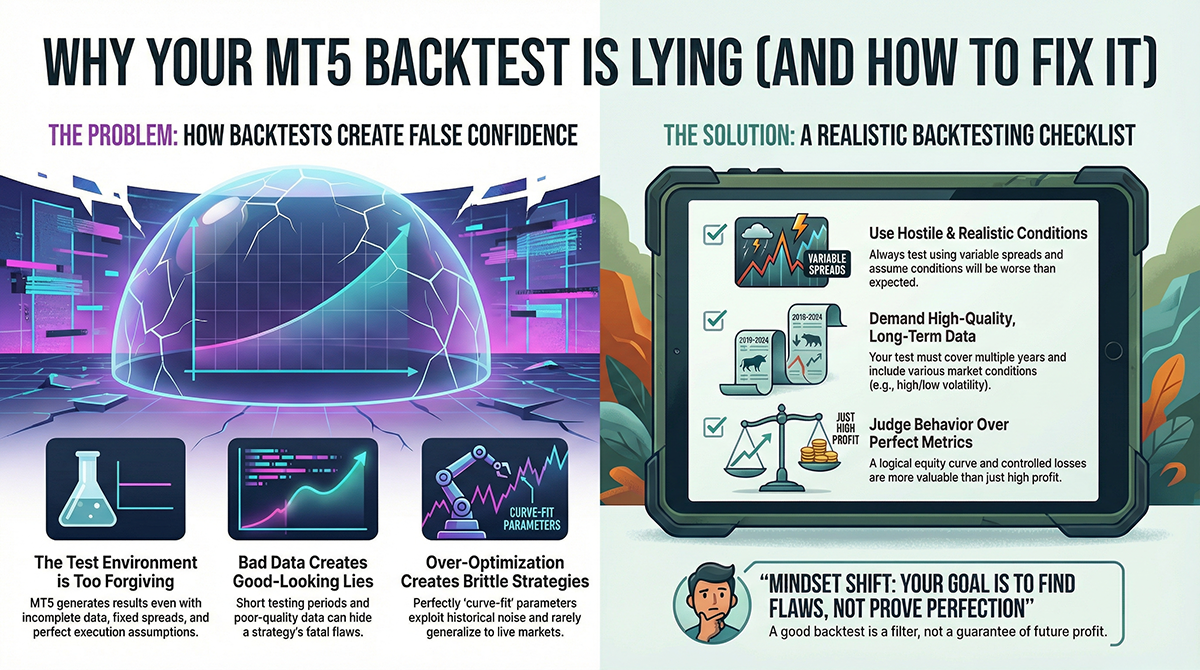
Backtesting is where most EA traders gain confidence. Unfortunately, it is also where most EA traders are misled. At 1kPips, we regularly see EAs with beautiful backtest curves, high profit factors, and impressive drawdown control that completely fail in live trading. In many cases, the strategy idea itself is not terrible. The problem is the backtest. This article explains how to backtest MT5 EAs the right way, and more importantly, how to avoid the kind of false confidence that quietly destroys trading accounts.
Why Most MT5 Backtests Lie
MT5 is powerful, but it is also very forgiving. It allows you to generate results even when:
- Historical data is incomplete
- Tick modeling is unrealistic
- Spreads are fixed and optimistic
- Execution is assumed to be perfect
The Strategy Tester will not warn you that your assumptions are wrong. It will simply produce numbers. If you do not control the testing environment carefully, those numbers are fiction.
Step 1: Understand What MT5 Is Actually Testing
Before running any test, you must understand what MT5 is simulating.
Key points many traders miss:
- Indicators may be calculated on generated ticks, not real ticks
- Spread behavior depends on tester settings, not broker reality
- Order execution timing is simplified
MT5 does not recreate the market. It recreates a model of the market. Your job is to make that model as hostile and realistic as possible.
Step 2: Historical Data Quality Is Non-Negotiable
Bad data creates good-looking lies.
Common data-related problems:
- Missing tick data
- Incorrect price spikes
- Inconsistent spreads
- Short testing periods
A backtest covering only a few months is not a test. It is a preview.
Professional EA testing uses:
- Multiple years of data
- Different market regimes
- High-volatility and low-volatility periods
If your EA only works in one market condition, the backtest should expose that, not hide it.
Step 3: Modeling Quality Is Not a Checkbox
Many traders see “99% modeling quality” and relax. This is a mistake. Modeling quality is a metric, not a guarantee.
You still need to ask:
- Are entries based on closed bars or current bars?
- Are indicators recalculated correctly?
- Is tick generation appropriate for the strategy type?
Scalping EAs are especially sensitive. Small inaccuracies in tick modeling can turn a losing scalper into a backtest hero. If your EA relies on a few points of edge, modeling assumptions matter more than win rate.
Step 4: Fixed Spreads Create Dangerous Illusions
Most backtests use fixed spreads. Real trading does not.
Spread widening during:
- Session opens
- Low liquidity hours
- Volatile news periods
Quietly destroys marginal strategies. If your EA cannot survive variable spreads in testing, it will not survive live. A conservative approach is always better. Assume spreads will be worse than you expect.
Step 5: Avoid the Optimization Trap
Optimization is where false confidence is born. A perfectly optimized EA often performs worse than a loosely tuned one.
Why:
- Optimizers exploit historical noise
- Perfect parameter sets rarely generalize
- Small changes destroy performance
When optimizing:
- Limit the number of parameters
- Use wide, logical ranges
- Look for stable clusters, not single peaks
If performance collapses when parameters move slightly, confidence should collapse with it.
Step 6: Use Forward Testing Inside the Tester
One of MT5’s most underused features is built-in forward testing.
Split your data:
- In-sample for development
- Out-of-sample for validation
A strategy that only works on the data it was optimized on is not a strategy. It is curve fitting. Forward testing inside the Strategy Tester exposes this quickly.
Step 7: Judge Behavior, Not Just Metrics
Many traders focus only on:
- Net profit
- Profit factor
- Max drawdown
These matter, but they are not enough.
You should also ask:
- Does the equity curve make sense?
- Are losses clustered or controlled?
- Does trade frequency align with logic?
An EA that behaves logically in bad periods is often more valuable than one that shines in good ones.
Why False Confidence Is So Dangerous
Because it feels earned. Charts look clean. Numbers look strong. You trust the system.
Then live trading introduces reality:
- Execution friction
- Spread variability
- Human expectations
The emotional damage of false confidence often causes traders to abandon good ideas too early or double down on broken ones.
A Practical Backtesting Mindset
- Assume your backtest is optimistic
- Try to break your EA in testing
- Welcome ugly results early
- Trust robustness over brilliance
Backtesting is not about proving you are right. It is about discovering how you might be wrong.
Backtests Are Filters, Not Guarantees
A good backtest does not promise profits. It earns your EA the right to be tested live, slowly, and cautiously. At 1kPips, we treat backtesting as a discipline, not a celebration. Avoid false confidence, and you give your EA something rare in trading: a real chance to survive.
Comments