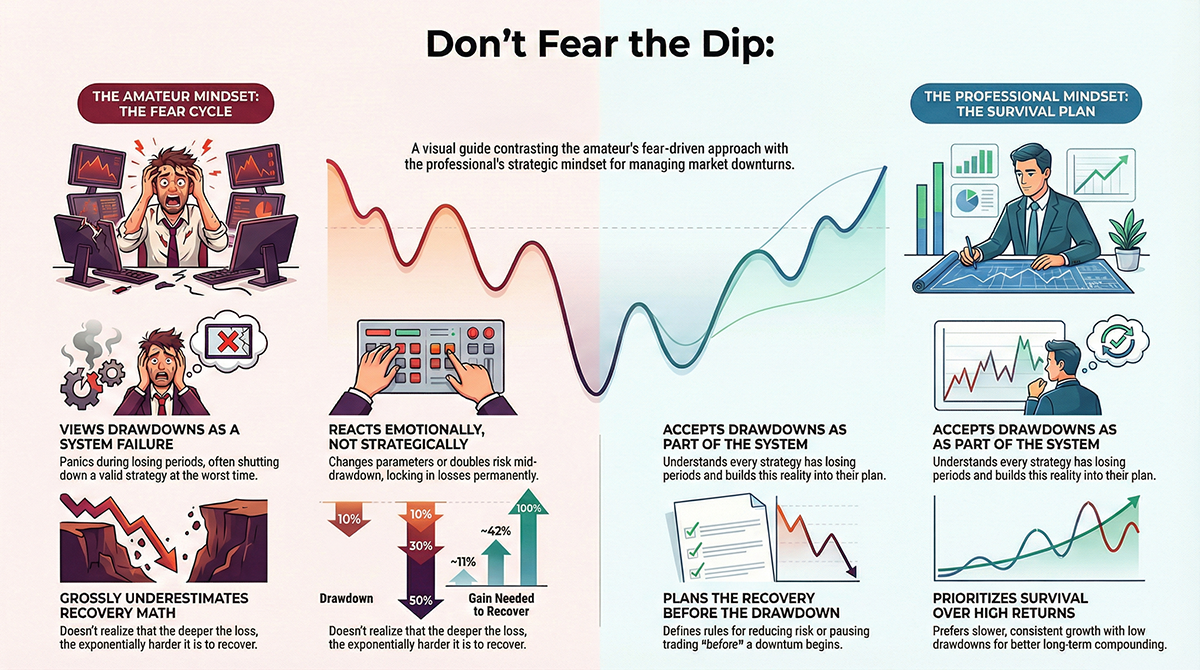
Every trader loves profits. Almost nobody likes drawdowns.
Yet in real trading, especially in automated systems, drawdowns are not a failure. They are part of the system.
At 1kPips, where we analyze EA performance and real equity curves, one thing is obvious:
Professional traders do not try to avoid drawdowns. They design their systems to survive them.
This article explains how professionals think about drawdowns, why amateurs fear them, and how EA traders should approach drawdown management realistically.
1. The First Truth: Drawdowns Are Inevitable
No strategy wins forever.
Markets change:
- Volatility expands and contracts
- Trends appear and disappear
- Sessions behave differently month to month
Because of this, every system experiences losing periods.
Professional traders accept this upfront. Retail traders often discover it too late.
If your system has no drawdown in backtests, it is either curve-fitted or not trading enough.
2. Professionals Read Equity Curves, Not Just Profit
Amateurs look at one number:
- Total return
Professionals look at the entire equity curve:
- Depth of drawdowns
- Frequency of drawdowns
- Duration of drawdowns
Two systems can make the same money and feel completely different to trade.
The equity curve tells you whether a trader or EA can realistically stick with the system.
3. Risk Tolerance Is Psychological, Not Mathematical
On paper, a 20 percent drawdown might look acceptable.
In reality, most traders cannot emotionally handle it.
Professional traders understand their true risk tolerance.
They ask:
- Can I sleep during this drawdown?
- Can I keep the EA running without interference?
- Will I change parameters at the worst moment?
The correct drawdown level is the one you can survive psychologically, not just financially.
4. Why Drawdown Percentage Is Misunderstood
A 10 percent drawdown needs about 11 percent to recover.
A 30 percent drawdown needs over 42 percent to recover.
A 50 percent drawdown needs 100 percent to recover.
Recovery becomes exponentially harder as drawdown increases.
Professional traders design systems that avoid deep holes, even if it means slower growth.
Staying in the game matters more than growing fast.
5. Professionals Plan the Recovery Before the Drawdown
Retail traders panic during drawdowns.
Professionals already know what they will do.
Common Professional Recovery Rules
- Reduce position size after equity drops
- Pause trading after predefined loss limits
- Allow the system to recover naturally without intervention
The key is that these rules are defined before losses happen.
This is especially important for EA traders, where emotional interference often destroys otherwise good systems.
6. Why Low Drawdown Beats High Returns
An EA that makes 20 percent a year with 8 percent drawdown is more valuable than:
- 50 percent a year with 40 percent drawdown
Lower drawdown means:
- Easier compounding
- Higher capital scalability
- Better long-term consistency
This is why professional money managers obsess over drawdown first, profit second.
7. EA Traders: Common Drawdown Management Mistakes
- Turning off EAs at maximum drawdown
- Changing parameters mid-drawdown
- Doubling risk to “recover faster”
- Judging systems on short timeframes
These actions often lock in losses permanently.
Drawdowns hurt most right before recovery.
Drawdowns Are the Cost of Staying in the Game
Professional traders do not fear drawdowns.
They respect them.
Drawdowns are the price paid for exposure to markets.
If your system is built to survive its worst periods, profits take care of themselves.
In trading, survival is the real edge.
Comments