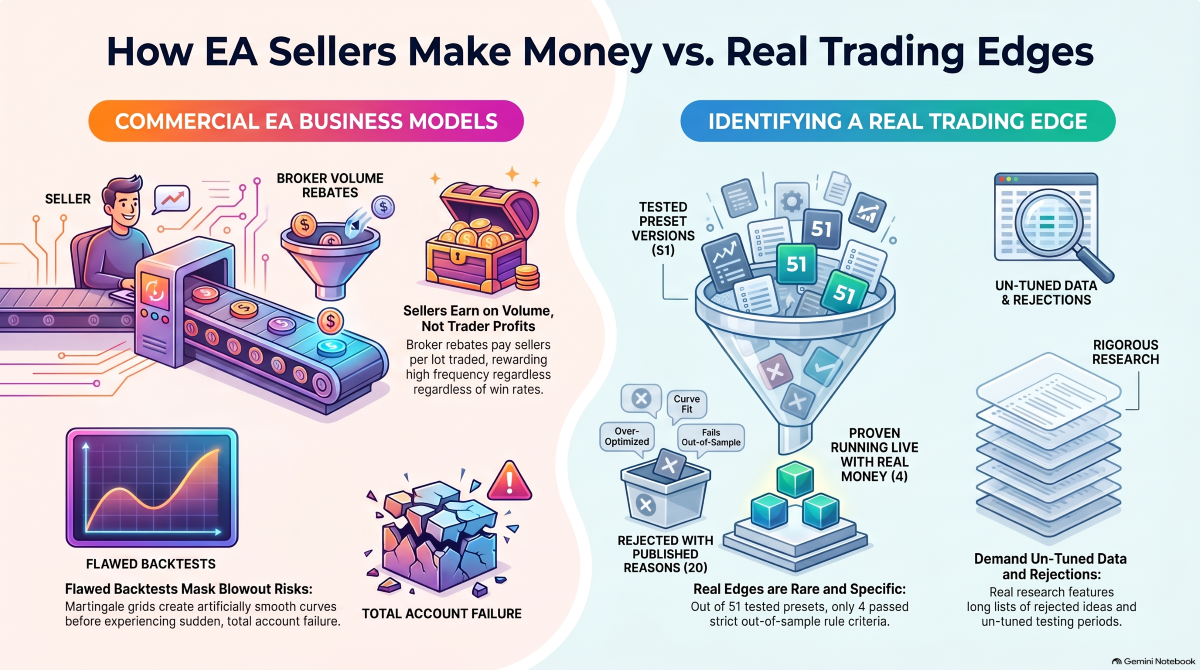
If you search for an Expert Advisor you will find thousands of them, almost all with a backtest that rises smoothly from the bottom left to the top right. It is worth asking a plain question before buying any of them: how does the person selling this make their money? The answer is usually not "by running it", and once you see the business models the backtests start to make sense.
Nothing below is about any particular vendor. These are the structures, and each one tells you what the EA has to do for its seller to get paid.
Six ways to make money from an EA
| Model | Where the money comes from | Does the EA have to work? |
|---|---|---|
| Selling the EA | A one-off price or a monthly rental, on a marketplace or a website | No. It has to look like it works at the moment of sale. The buyer finds out afterwards. |
| Broker rebates | The EA is free, but only on a partner broker. The seller earns a rebate on every lot it trades. | No. The seller is paid on volume, whether the trades win or lose. An EA that trades often earns more. |
| Signal and copy-trading subscriptions | Followers pay monthly to copy a live account | For a while. Many accounts can be started; the ones that happen to do well get marketed. |
| Martingale and grid systems | Usually sold, rented or rebated, as above | It appears to, until it does not. See below. |
| Managed accounts | A share of the profit on other people's money | Yes, at least long enough to attract the money. |
| Running a real edge yourself | Trading profits on your own account | Yes. And people in this position rarely sell. |
The last row is the important one. A real edge has limited capacity: it pays a few pips on a few days, and the more money chases it the less it pays. Selling it to everyone destroys it. So the incentives sort themselves: the EAs most widely sold are, structurally, the ones whose sellers do not need them to work.
Why the backtest always looks good
The MT5 strategy tester will find settings that would have worked on any history, including random data. Optimise twenty parameters over three years and the best combination will look excellent, because it was chosen after seeing the answer. We cover this in detail in A Backtest Is Not Evidence. The short version: a backtest is only evidence when the rule was fixed before the data it is judged on, and when it holds on a period nobody tuned it to.
Ask any seller two things. Which period was the system tuned on, and how did it do on a period it was not tuned on? If the answer is a single unbroken curve, you are looking at the tuning.
The martingale shape
A martingale or grid EA adds to a losing position instead of closing it, so that a small move back recovers everything. Most of the time the move back comes. The result is a very high win rate and a beautifully smooth equity curve, for months. Then a market trends hard in one direction without pausing, the position doubles past what the account can hold, and one trade takes back everything at once.
Nothing about the strategy changed on the day it failed. The risk was there on every one of the good days; it just had not been sampled yet. A smooth curve with no losing months is not reassuring. In this business it is often the warning.
Rebates reward trading, not winning
The quietest model is also probably the largest. When an EA is free on a partner broker, the seller earns on the volume it generates. Each trade costs the user the spread and pays the seller a share of it. An EA that trades fifty times a day at break-even before costs is a losing system for its user and a good business for whoever introduced the account. Nothing illegal is happening; the incentive simply points away from the user.
If an EA is free, find out which broker it requires and whether the person recommending it is paid per lot. If they are, they should say so.
What it looks like when nobody is selling anything
1kPips does not sell EAs. The code is public, every preset we have tested is on the presets page with its parameters and its runs, and the live record is reported by the EAs themselves as trades close. So we can show what honest EA research produces when there is nothing to market. It is less exciting than a sales page.
| What we have filed | Count |
|---|---|
| Preset versions on the presets page | 51 |
| Rejected, with the reason published | 20 |
| Candidates (some evidence, did not pass every rule) | 9 |
| Running live with real money | 8 |
| Of those, labelled proven | 4 |
The four proven presets are all one idea: the Tokyo fix. Japanese importers have to buy dollars at 09:55 JST on known dates, and on those dates the yen crosses fall after the fix. It held in every window we could test it on, out of sample back to 2010, and it pays about a quarter of a dollar per trade at the minimum lot. That is what a real edge looks like: small, specific, and with a reason behind it.
Most of our work is rejections. In a single day of research in October we tested eight ideas against rules written down before each test was run. Here are some of them:
- Using our daily signal readings to switch our range-reversion EA on and off. Failed: the readings meant opposite things in different decades.
- Running that same EA back to 2010 for the first time. It lost over 1,805 trades (profit factor 0.85). Its good years, 2023 to 2026, turned out to be the exception rather than the rule, so we downgraded its label the same day, while it is still running.
- The Tokyo fix on three more yen pairs. Two rejected, one candidate.
- Momentum into the US stock-market close, a published effect. It worked in 2019-22 and has run the other way since 2023.
- A rule that turns an EA off when its recent results are bad. It avoided losses only by trading less, and it recognised the good period about two years late.
- The turn-of-the-month effect in US indices, and month-end currency hedging flows. Both were well documented, and both have faded since they were published.
One of the eight, fading the move into the US close, looked significant, but only because we had gone looking. So we wrote the rule down and it will be judged on data from September 2026 onward, with the verdict date set in advance. It takes about two years, because a small edge needs that long to tell apart from luck. A seller would have shipped it the same afternoon.
And the live record? At the time of writing it is ten trades since the account was funded properly on 13 October. That is far too few to mean anything, and we publish it anyway, from the first trade, because a record that starts at trade thirty has already been chosen.
Five questions to ask before you trust an EA
- How does the seller get paid? Sale, rental, rebate or subscription. If it is anything other than "by running it", the EA does not need to work for them.
- What was it tuned on, and what was it tested on? Without a period the settings never saw, the backtest is only the tuning.
- What is the worst losing streak, and what happens to the position size during one? If the size grows while losing, it is a martingale, however it is described.
- Is there a live record from the first trade, reported by the account itself, including the accounts that stopped?
- What did they reject? Someone doing real research has a long list of things that did not work. Someone selling has only the one that did.
The fifth question is the one we would ask first. A long, published list of failures is the most honest evidence you can find that somebody is actually testing ideas, and it is the hardest thing for a sales page to fake.
Nothing on this site is investment advice. Every figure above is a backtest, a measurement on one broker's data, or a live result at minimum lot size, published so that it can be checked.
Comments