Almost every EA starts the same way.
“I noticed something interesting on the chart.”
An indicator behaves differently in certain conditions. A pattern repeats during a session. Price reacts around a level more often than expected. The idea feels obvious once you see it.
Then reality hits.
You try to turn that idea into an MT5 EA, and suddenly nothing works the way you imagined.
At 1kPips, this gap between idea and execution is where most EA projects quietly fail. Not because the idea is bad, but because the path from indicator logic to live order execution is misunderstood.
This article walks through that full journey: how professional EA developers translate trading ideas into robust MT5 EAs, step by step, without turning a simple concept into an unmaintainable mess.
The First Mistake: Treating Indicators as Strategies
Indicators do not trade.
They describe something.
Yet many EA projects begin with a sentence like:
“When RSI crosses 30, buy.”
This is not a strategy.
It is a condition.
A real EA needs answers to much harder questions:
- In what market conditions does this matter?
- How often should it act?
- What invalidates the idea?
- What happens when execution is imperfect?
Indicator logic is the seed, not the system.
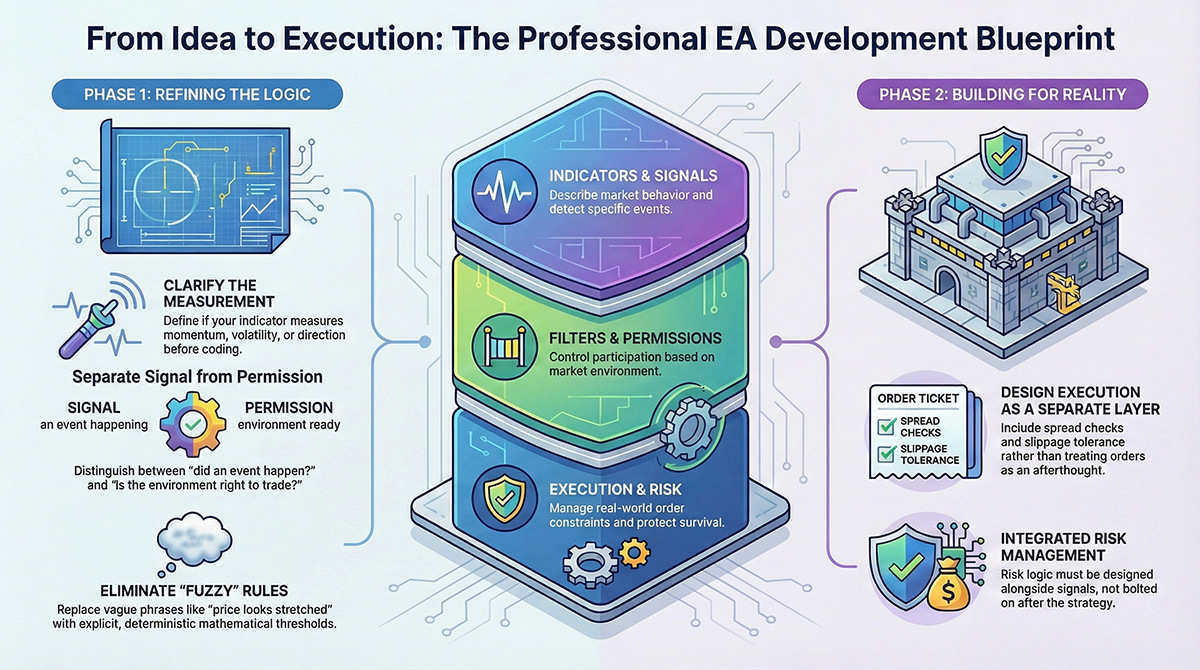
Step 1: Clarify What the Indicator Is Measuring
Before writing a single line of MQL5, you must understand what your indicator actually represents.
Ask:
- Is it measuring direction?
- Is it measuring momentum?
- Is it measuring volatility?
- Is it measuring relative position?
Most indicators are misunderstood because they are treated as signals instead of measurements.
For example:
- RSI measures relative momentum, not “overbought”
- Bollinger Bands measure volatility, not support and resistance
- Moving averages measure smoothing, not trend certainty
If you cannot explain what your indicator measures in one sentence, you are not ready to automate it.
Step 2: Separate Signal Detection From Trade Permission
One of the biggest EA design improvements is separating:
- Signal detection
- Trade permission
A signal answers:
“Did something interesting happen?”
Permission answers:
“Should I act on it right now?”
Many EAs mix these together and become fragile.
Professional EAs allow signals to occur frequently, but only act when the environment supports them.
Step 3: Define Signal Timing Explicitly
This is where many backtests lie.
You must decide:
- Is the signal evaluated on a closed bar?
- Is intrabar behavior relevant?
- Does the signal persist or vanish quickly?
Closed-bar signals are slower but honest.
Intrabar signals are faster but dangerous.
If this decision is unclear, your EA will behave differently in backtest and live trading.
Step 4: Translate Logic Into Deterministic Rules
Human ideas are fuzzy.
EAs are not.
Phrases like:
- “Price looks stretched”
- “Momentum is fading”
- “The move feels weak”
Must become:
- Explicit thresholds
- Time-based conditions
- Clear invalidation rules
This translation often reveals that the original idea was incomplete.
That is a good thing.
Step 5: Design Execution as a Separate Layer
Execution is not just sending orders.
It includes:
- Spread checks
- Slippage tolerance
- Order retry logic
- Broker constraints
Many EA developers focus heavily on signals and treat execution as an afterthought.
In live trading, execution quality often matters more than signal brilliance.
A mediocre signal with clean execution can outperform a great signal with poor execution.
Step 6: Risk Logic Is Not Optional Glue
Risk management is not something you “add later”.
It shapes the entire EA behavior.
Decisions about:
- Position sizing
- Maximum exposure
- Trade frequency limits
Must be designed alongside signal logic, not bolted on afterward.
Many promising EAs fail because risk logic contradicts signal assumptions.
Step 7: Expect the Idea to Change During Coding
This surprises many traders.
Coding exposes weaknesses that charts hide.
When forced into precise rules:
- Some ideas lose their edge
- Some become simpler
- Some reveal hidden assumptions
This is not failure.
It is refinement.
Why Many Indicator-Based EAs Disappoint
They skip steps.
They jump from:
“Indicator X looks good”
Straight to:
“Let’s optimize it.”
Without designing:
- Context filters
- Execution realism
- Risk boundaries
Optimization cannot fix missing structure.
A Professional EA Development Mental Model
- Indicators describe behavior
- Signals detect events
- Filters control participation
- Execution manages reality
- Risk protects survival
Each layer has a job.
Mixing them creates fragile systems.
Why This Process Feels Slower but Pays Off
Yes, this approach takes longer.
Yes, it produces fewer “exciting” backtests early on.
But it creates EAs that:
- Behave consistently
- Can be debugged
- Can be improved without fear
- Survive real market conditions
Speed builds demos.
Process builds systems.
Ideas Are Cheap, Execution Is Everything
Most traders have good ideas.
Very few turn them into durable EAs.
At 1kPips, we believe the real edge is not discovering indicators, but learning how to transform ideas into systems that respect market behavior, execution reality, and risk.
When you master that translation, indicators stop being magic tools and start becoming building blocks.
Comments