At 1kpips.com, we see it every day: a trader finds a killer EA or a high-accuracy signal, but three months later, their account is in the bin. Why? Because they treated money management like an afterthought. They had the engine (the strategy) but they didn't have the transmission (the lot sizing).
In the world of automated trading and professional signals, your lot sizing strategy is the only thing standing between you and a "Margin Call" email. Today, we’re putting the two heavyweights in the ring: Fixed Lot vs. Percent Risk (Risk-Based). Grab a coffee; this is where you stop gambling and start trading.
1. The "Old Reliable": Fixed Lot Sizing
Fixed lot sizing is as simple as it sounds. You decide, "I am going to trade 0.1 lots on every single trade," regardless of whether your Stop Loss is 10 pips or 100 pips. It’s the favorite of beginners and some specific "Grid" or "Martingale" EAs.
The Pros:
- Simplicity: You don't need a calculator. Set it and forget it.
- Predictability: You know exactly what 10 pips is worth every time.
The "Hidden" Danger:
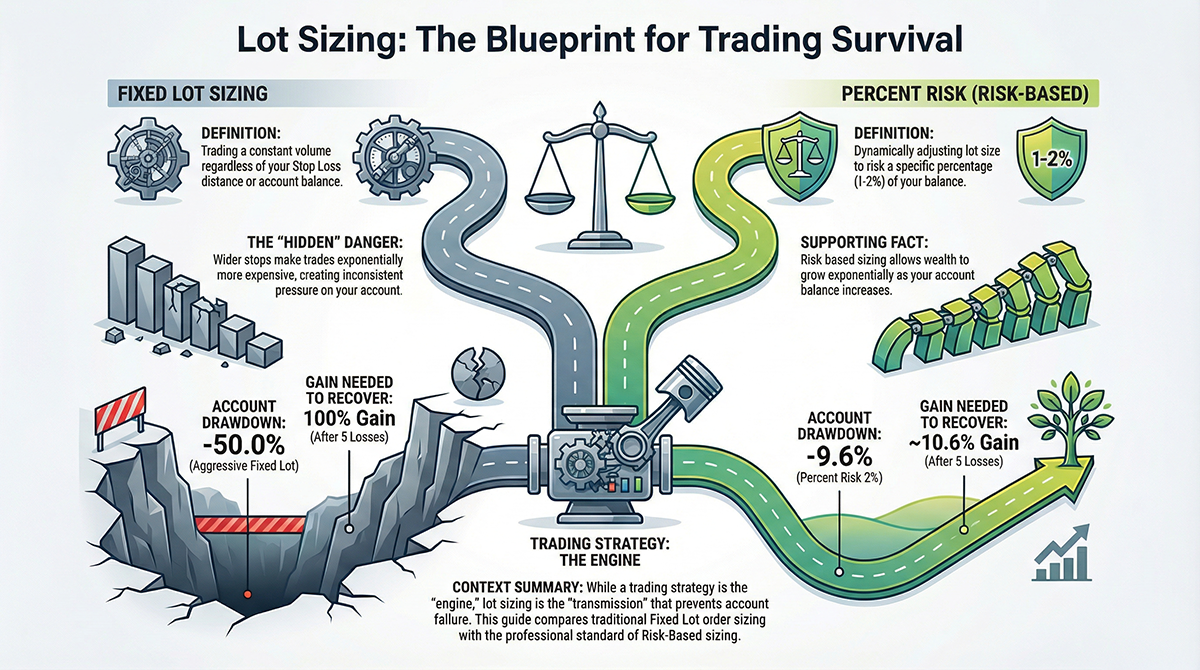
The problem with fixed lots is that it ignores the geometry of the trade. If Trade A has a 20-pip stop and Trade B has a 60-pip stop, Trade B is effectively 3x more "expensive" if it hits your Stop Loss. This creates inconsistent pressure on your account. One bad trade with a wide stop can wipe out five "good" trades with tight stops.
2. The "Pro's Choice": Risk-Based (Percent Risk)
This is the money management gold standard. Here, you decide to risk a specific percentage of your balance (usually 1% to 2%) per trade. Your lot size changes dynamically based on your Stop Loss distance.
If you have a $10,000 account and risk 1% ($100):
- A 10-pip Stop Loss = 1.0 Lot
- A 50-pip Stop Loss = 0.20 Lot
The Pros:
- Equalized Risk: Every trade "hurts" the same. No single trade can wreck your psychology.
- Compounding Power: As your account grows, your 1% becomes a larger dollar amount, allowing your wealth to grow exponentially without increasing your "danger" level.
The Cons:
It requires math (or a good EA/Indicator). It also means that when your account is in a drawdown, your lot sizes get smaller—making it feel slower to "climb back out" of the hole.
The Math of Survival: A Tale of Two Traders
Let’s look at a 10-trade sequence where the trader loses 5 in a row then wins 5 in a row.
| Scenario | Outcome after 5 Losses | Recovery Requirement |
|---|---|---|
| Fixed Lot (Aggressive) | -50% Account | Needs 100% Gain to break even |
| Percent Risk (2%) | -9.6% Account | Needs ~10.6% Gain to break even |
The percent risk trader is still in the game, calm and collected. The fixed lot trader is likely sweating, swearing at their screen, and looking for a "Holy Grail" to save them. This is why 1kpips always advocates for dynamic risk—especially when using automated signals.
Which One Works Long Term?
If you are running a High-Frequency Scalping EA with very tight, uniform stops, Fixed Lot can work because the "risk per trade" is naturally standardized.
However, for 90% of traders, the Percent Risk model is the only way to survive the "Market Noise" for years rather than weeks. It turns trading from a game of "catching a lucky streak" into a professional business of "managing an equity curve."
Don’t Let Your Ego Pick Your Lot Size
The market is a giant machine designed to separate you from your money. It uses your emotions—pride, greed, and impatience—against you. Choosing a lot sizing strategy based on math instead of "feeling" is your first line of defense.
A Fixed Lot is a static target. A Risk-Based Lot is a moving shield. If you’re serious about making it to the "1,000 Pips Club," stop guessing how much to click. Calculate it. Respect it. And let the statistics do the work.
The Final Reality Check: If your strategy can't survive 10 losses in a row using a 1% risk model, the problem isn't your lot sizing—it's your strategy. Build on a solid foundation, and the profits will follow.
Comments