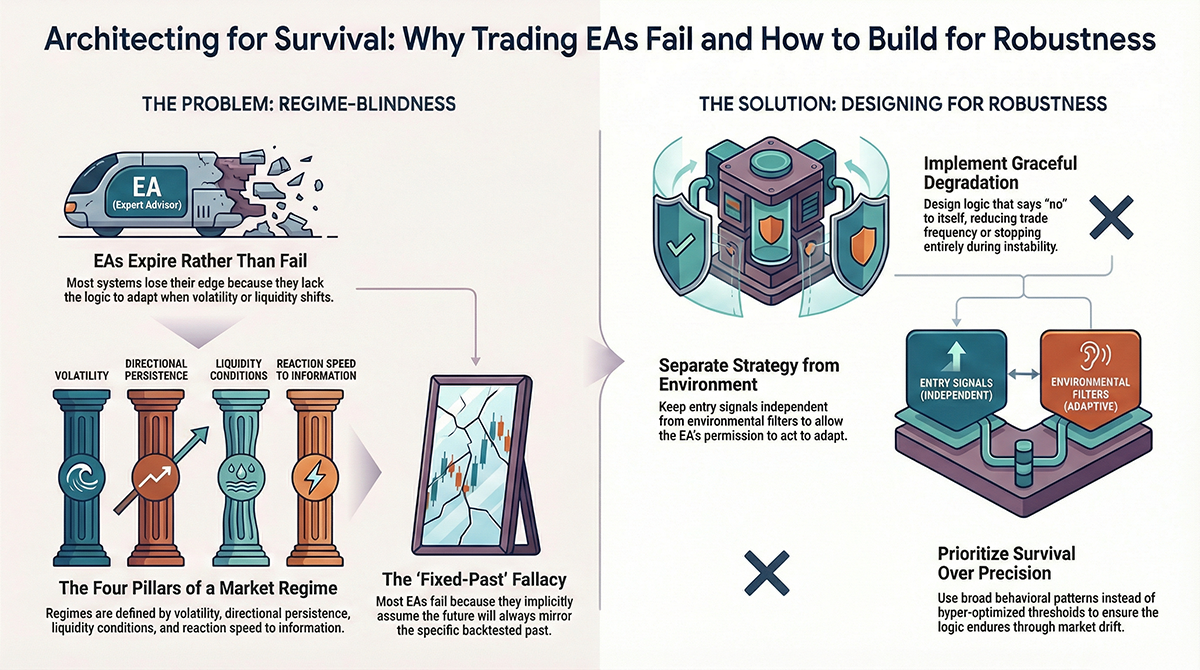
Most Expert Advisors don’t actually fail.
They expire.
They work well for months, sometimes even years, and then slowly lose their edge. Trades become less frequent. Drawdowns last longer. Recovery feels harder. Eventually the EA is turned off, not because it exploded, but because confidence quietly disappeared.
At 1kPips, this pattern shows up again and again. And in most cases, the core issue is not bad code or a bad strategy idea.
The issue is that the EA was designed for a single market regime, even if the developer did not realize it.
This article explains what market regime changes really mean for EA developers, why most EAs are fragile by design, and how to build EA logic that survives regime shifts instead of being destroyed by them.
What Market Regime Changes Actually Are
A market regime is not a label like “trend” or “range”.
It is a combination of:
- Volatility behavior
- Directional persistence
- Liquidity conditions
- Reaction speed to information
Regime changes occur when one or more of these characteristics shifts meaningfully.
For example:
- A quiet range becomes volatile but still directionless
- A smooth trend turns into sharp, news-driven spikes
- Mean reversion stops working because volatility expands
These changes do not announce themselves clearly.
They emerge gradually, then suddenly matter a lot.
Why Most EA Logic Is Regime-Blind
Many EAs are built around a single implicit assumption:
“The future will look roughly like the past I tested.”
This assumption is rarely stated, but it is embedded in:
- Tightly optimized parameters
- Fixed stop and target logic
- Always-on trading behavior
When the regime changes, nothing in the EA adapts.
The logic keeps firing signals that no longer make sense.
The EA is not broken.
It is simply out of context.
The Wrong Approach: Trying to Predict Regimes
Many traders respond to regime issues by trying to predict them.
They add:
- More indicators
- More thresholds
- More conditional branches
The EA becomes complex, slow, and fragile.
Predicting regime changes precisely is extremely difficult.
Surviving them is much easier.
Robust EAs do not try to forecast regime shifts.
They are designed to fail gracefully when conditions change.
Core Principle: Regime Awareness Beats Regime Prediction
A regime-aware EA asks simple questions:
- Is volatility expanding or contracting?
- Is price movement persistent or rotational?
- Is the market behaving normally or unusually?
It does not need exact labels.
It needs boundaries.
The goal is not to trade perfectly in every regime.
The goal is to avoid trading aggressively in the worst ones.
Designing Logic That Degrades Gracefully
One of the most important EA design ideas is graceful degradation.
A robust EA should:
- Trade less when conditions worsen
- Reduce exposure during instability
- Stop trading entirely when assumptions break
This requires logic that can say “no” to itself.
Always-on EAs are the most fragile.
Separating Strategy From Environment
A common design mistake is mixing entry logic with environmental logic.
For example:
- Entry conditions change based on volatility
- Risk logic is embedded inside signal rules
- Market filters are scattered across code
This makes adaptation dangerous.
Instead, robust EAs separate:
- Market environment detection
- Strategy eligibility
- Execution logic
The strategy does not change.
Its permission to act does.
Adaptive Does Not Mean Reactive
Many EAs overreact to short-term noise.
They flip modes too frequently.
This creates:
- Whipsaw behavior
- Inconsistent trade logic
- Optimization instability
Adaptation should be slow, deliberate, and conservative.
If regime detection changes state every few bars, it is not detecting regimes.
It is reacting to noise.
Why Robust EAs Trade Less Over Time
This surprises many traders.
EAs that survive long-term often reduce trade frequency as markets evolve.
Why:
- Edges decay
- Volatility regimes shift
- Market participants change
A system that insists on constant activity will force trades.
A robust system waits.
Designing for Uncertainty, Not Precision
Precision-focused EAs rely on:
- Tight thresholds
- Exact parameter values
- Highly specific setups
These systems break when conditions drift.
Robust EAs rely on:
- Broad condition ranges
- Behavioral patterns
- Risk containment
They may look less impressive in backtests.
They usually last longer live.
Testing for Regime Survival
To test regime robustness, ask:
- Does the EA behave logically during high volatility?
- Does it reduce activity in unstable periods?
- Can it survive long flat periods?
A system that only looks good in one slice of history is not robust.
It is specialized.
Why Regime-Surviving Logic Feels Uncomfortable
Because it trades less.
Because it says “no” often.
Because it does not maximize backtest metrics.
But comfort is not the goal.
Survival is.
Markets Change, Logic Must Endure
You cannot control market regimes.
You can control how your EA responds to them.
At 1kPips, we believe strong EA logic is not defined by how it performs in ideal conditions, but by how it behaves when conditions drift, distort, and disappoint.
Design for regime survival, and performance has a chance to compound.
Comments