Most losing EAs don’t fail loudly.
They don’t crash. They don’t throw errors. They don’t stop trading.
They just slowly underperform.
At 1kPips, we review a large number of EAs that look perfectly fine on the surface. Clean backtests. No compiler warnings. Reasonable logic. Yet live results quietly decay over time.
In almost every case, the problem is not the strategy idea.
It is a coding mistake—small, subtle, and dangerous.
This article walks through the most common EA programming mistakes that quietly kill performance, especially in MQL5. If you recognize even one of these in your code, you may already know why your EA is underdelivering.
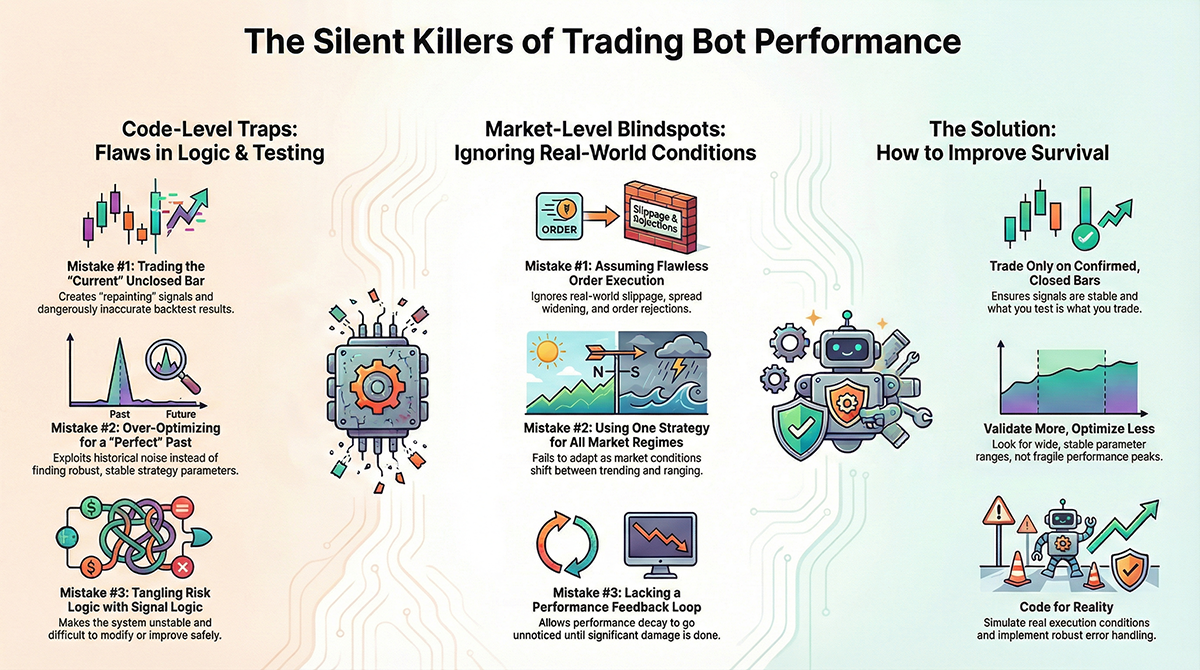
Mistake #1: Trusting the Current Bar
This is the classic EA killer.
Using indicator values from the current, still-forming bar creates:
- Repainting signals
- Fake backtest accuracy
- Unstable live behavior
Backtests love current-bar logic. Live trading punishes it.
If your EA uses:
iRSI(..., 0)Instead of:
iRSI(..., 1)You are not trading the same signals you tested.
This mistake alone can explain:
- Why live win rate is lower
- Why entries feel “late” or “random”
- Why optimization results never repeat
Mistake #2: Over-Optimizing Parameters Without Context
Optimization is a double-edged sword.
Many EAs die not because they are unoptimized, but because they are over-optimized.
Common symptoms:
- Dozens of input parameters
- Perfect equity curve in backtest
- Sharp drawdown immediately in live
The mistake is treating optimization as intelligence.
Optimizers do not understand markets. They exploit noise.
Professional EA developers optimize:
- Few parameters
- With wide, stable ranges
- Looking for plateaus, not peaks
If your EA only works at RSI=37 and breaks at 36 or 38, performance is already dead.
Mistake #3: Ignoring Execution Reality
Many EAs assume perfect execution.
Live trading does not.
Common silent execution killers:
- Spread widening during entry
- Slippage during news or volatility
- Order rejection not handled
- Latency differences across brokers
If your EA:
- Does not check spread
- Does not validate SL/TP distance
- Assumes order success
Then your backtest and live results are two different systems.
Execution mistakes do not always cause obvious errors. They simply reduce average trade quality.
Mistake #4: Poor Trade Frequency Control
More trades does not mean more profit.
But uncontrolled trades almost always mean more noise.
Common issues:
- No cooldown between trades
- Multiple entries on the same signal
- Re-entry loops after quick exits
These bugs don’t break the EA. They just inflate trade count with low-quality setups.
Over time, expectancy drops quietly.
Every EA should explicitly answer:
“When should I NOT trade?”
Mistake #5: Mixing Risk Logic With Signal Logic
This mistake does not reduce performance immediately.
It destroys performance over time.
When risk management is tangled with entry logic:
- Small strategy changes cause large behavior shifts
- Position sizing becomes unpredictable
- Drawdown behavior becomes unstable
Risk logic should be boring, isolated, and predictable.
Signal logic can evolve.
Mixing the two makes optimization dangerous and refactoring scary.
Mistake #6: Ignoring Market Regimes
Many EAs assume the market is always the same.
It is not.
Without basic regime awareness:
- Trend systems bleed in ranges
- Mean reversion dies in breakouts
- Scalpers fail during volatility spikes
Even simple filters (ATR, ADX, session filters) dramatically improve survival.
Ignoring regime changes doesn’t cause instant failure. It causes slow performance erosion.
Mistake #7: No Performance Feedback Loop
Many traders deploy an EA and hope.
Professional systems observe and adapt.
If your EA:
- Does not log meaningful metrics
- Does not track win rate shifts
- Does not detect drawdown behavior
Then performance decay will go unnoticed until damage is done.
Silent failure is worse than visible failure.
Why These Mistakes Are So Dangerous
Because they don’t announce themselves.
Your EA keeps trading. Your account does not blow up. Results just… drift lower.
Many traders blame:
- Market conditions
- Broker issues
- Bad luck
Often, the real problem is a few lines of code written months ago.
How to Protect Your EA From Silent Death
- Trade only closed-bar signals
- Optimize less, validate more
- Simulate real execution conditions
- Control trade frequency explicitly
- Separate logic cleanly
- Log and review performance data
None of these improve strategy brilliance.
They improve survival.
Final Thought: Performance Rarely Dies in One Trade
EAs usually die quietly.
One small assumption. One hidden bug. One unchecked condition.
At 1kPips, we believe long-term profitability is less about clever ideas and more about avoiding silent killers.
Fix the quiet mistakes, and performance has a chance to speak again.
Permalink: /en/blog/common-ea-coding-mistakes-performance
Comments