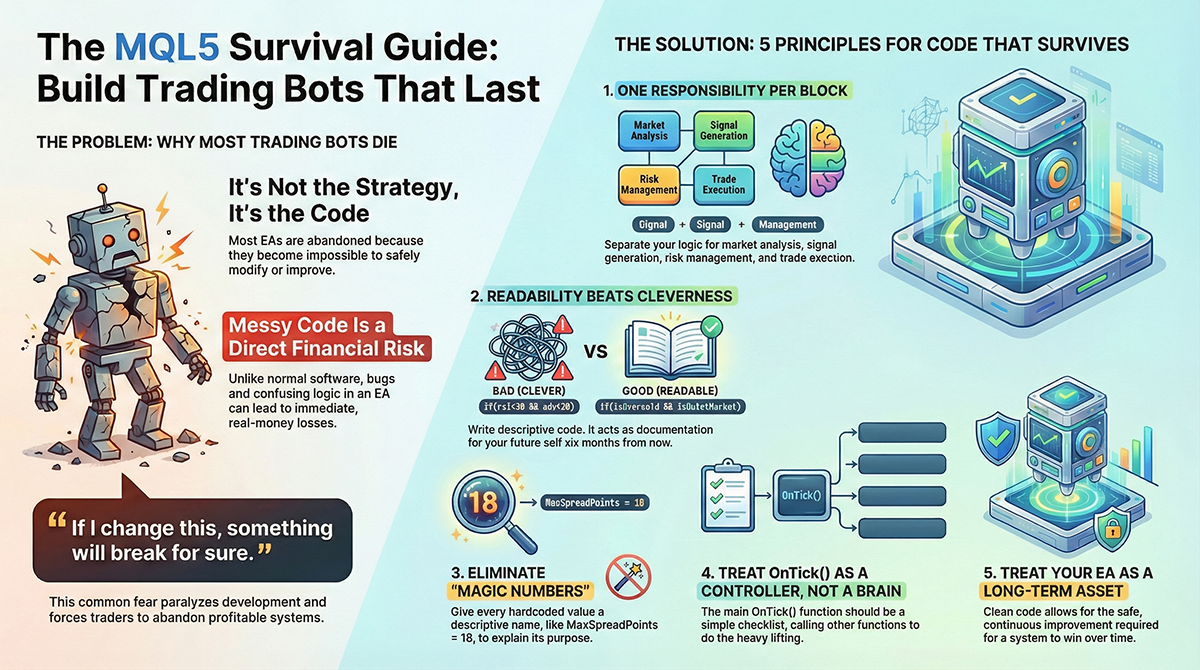
Most EAs don’t die because the strategy is bad.
They die because the code becomes impossible to touch.
If you have ever opened an old .mq5 file and thought:
- “Why did I write this?”
- “What does this variable even do?”
- “If I change this, something will break for sure.”
You are not alone.
At 1kPips, we see this all the time. Traders build profitable EAs, then abandon them because the codebase turns into a fragile mess. Clean MQL5 code is not about elegance or academic purity. It is about survival.
This article is a practical, EA-focused guide to writing MQL5 code you can maintain for years, not weeks.
Why Clean Code Matters More in EAs Than Anywhere Else
Unlike normal applications, EAs live in an environment where:
- Market behavior changes constantly
- Parameters need frequent tuning
- Strategies evolve after live feedback
- Bugs cost real money, not just errors
That means your EA code will be:
- Read again (by you, months later)
- Modified repeatedly
- Stress-tested under live conditions
Messy code turns every small change into a risk event. Clean code turns refactoring into a routine operation.
Principle #1: One Responsibility Per Block
The fastest way to destroy maintainability is to mix everything together.
Bad EA structure (very common):
- Indicator calculation inside
OnTick() - Risk logic mixed with entry logic
- Session filters hardcoded everywhere
- Magic numbers scattered across files
A clean EA separates responsibilities clearly:
- Market state detection
- Signal generation
- Risk & position sizing
- Execution & order management
- Safety filters
Each block should answer one question:
“Is this the right moment?”
“Is risk acceptable?”
“Should I execute now?”
Principle #2: Readability Beats Cleverness
MQL5 allows extremely compact code. That is a trap.
This:
if(rsi<30 && adx<20 && close<bbL)Is shorter than this:
bool isOversold = rsi < RsiOversoldLevel;
bool isQuietMarket = adx < AdxQuietThreshold;
bool isOutsideLowerBand = close < bbLower;

if(isOversold && isQuietMarket && isOutsideLowerBand)
But only the second version survives long-term maintenance.
When you come back six months later, descriptive variables are documentation. Short expressions are puzzles.
Principle #3: Kill Magic Numbers Early
Magic numbers destroy EA clarity faster than any syntax issue.
Bad:
if(spread > 18) return;Good:
input int MaxSpreadPoints = 18;

if(spread > MaxSpreadPoints) return;
Every number in your EA should answer:
- Why this value?
- Can it change?
- Will optimization touch it?
If the answer is unclear, promote it to an input or a named constant.
Principle #4: Treat OnTick() as a Controller, Not a Brain
One of the biggest EA mistakes is turning OnTick() into a monster function.
A clean OnTick() should read almost like English:
void OnTick()
{
    if(!IsTradingTime()) return;
    if(!IsMarketSafe()) return;
    if(!HasNoOpenPosition()) return;

    if(HasValidSignal())
        ExecuteTrade();
}
If your OnTick() exceeds 50–70 lines, your EA is already aging badly.
Principle #5: Refactor Like You Expect to Win
Many traders don’t refactor because they subconsciously assume:
“This EA probably won’t last anyway.”
That mindset becomes self-fulfilling.
Professional EA developers refactor because:
- Good logic deserves a long life
- Winning systems evolve slowly
- Small improvements compound over years
Refactoring is not rewriting. It is clarifying intent without changing behavior.
Practical Refactoring Checklist for Existing EAs
If you already have a messy EA, start here:
- Rename unclear variables
- Extract logic into functions
- Group inputs logically
- Remove dead code and commented blocks
- Add comments that explain why, not what
Even one refactoring pass dramatically improves future work speed.
Why Clean Code Improves Performance Indirectly
Clean code does not magically increase win rate.
But it allows:
- Faster testing cycles
- Safer optimizations
- Better risk logic iteration
- Clearer performance analysis
In algo trading, execution quality beats theoretical brilliance. Clean code supports execution quality.
Final Thought: Your EA Is an Asset
Treat your EA like a disposable script, and it will behave like one.
Treat it like a long-term asset, and clean MQL5 code becomes a competitive advantage.
At 1kPips, we believe profitable systems are built not just on signals, but on code you are confident enough to improve again and again.
Clean code is how you stay in the game long enough to win.
Comments